
 https://doi.org/10.4081/ahr.2026.202
ADVANCES IN THE PATHOPHYSIOLOGY AND MANAGEMENT OF CANCER PAIN: A SCOPING REVIEW
Y. Tran Van1, A. Paladini2, V.P. Pham1, A.A. Al Alwany3, G. Farì4, A. Caruso5, M. Mercieri6, M.L.G. Leoni7, J.V. Pergolizzi8, A.D. Kaye9, F. Breve10, A. Corriero11, C. Gharibo12, G. Varrassi13 | 1Department of Biomedical Engineering, International University, Vietnam National University, Ho Chi Minh City, Vietnam; 2Department of Life, Health and Environmental Sciences, University of L'Aquila, Italy; 3College of Medicine, University of Baghdad, Iraq; 4Department of Experimental Medicine (Di.Me.S.), University of Salento, Lecce, Italy; 6Department of Surgery, ASST Lodi, Lodi, Italy; 7Department of Medical and Surgical Sciences and Translational Medicine, Sapienza University of Rome, Italy; 8NEMA Research Inc., Naples, FL, USA; 9Department of Anesthesiology, LSU Health, Shreveport, LA, USA; 10School of Pharmacy, Temple University, Philadelphia, PA, USA; 11Department of Interdisciplinary Medicine, University of Bari "Aldo Moro", Bari, Italy; 12Department of Anesthesiology, NYU Grossman School of Medicine, New York, NY, USA; 13Fondazione Paolo Procacci, Rome, Italy
All claims expressed in this article are solely those of the authors and do not necessarily represent those of their affiliated organizations, or those of the publisher, the editors and the reviewers. Any product that may be evaluated in this article or claim that may be made by its manufacturer is not guaranteed or endorsed by the publisher.
Published: 6 May 2026
Background and Aims. Cancer pain affects 55–95% of patients with advanced malignancy, representing a complex syndrome involving nociceptive, neuropathic, and nociplastic mechanisms. Despite therapeutic advances, two-thirds of patients with metastatic cancer experience inadequate pain control. This scoping review synthesizes recent advances in cancer pain pathophysiology and management, focusing on molecular and cellular mechanisms, emerging pharmacological, interventional and technological therapies, and key evidence gaps to inform future precision-based pain management strategies
Methods. Following PRISMA-ScR methodology, we searched PubMed, Embase, Scopus, and Web of Science for studies published between January 2022 and September 2025. After screening 3412 records, 278 studies were included and analyzed across different domains: biological mechanisms, pharmacological management, interventional and neuromodulatory approaches, radiotherapy developments, and digital health innovations
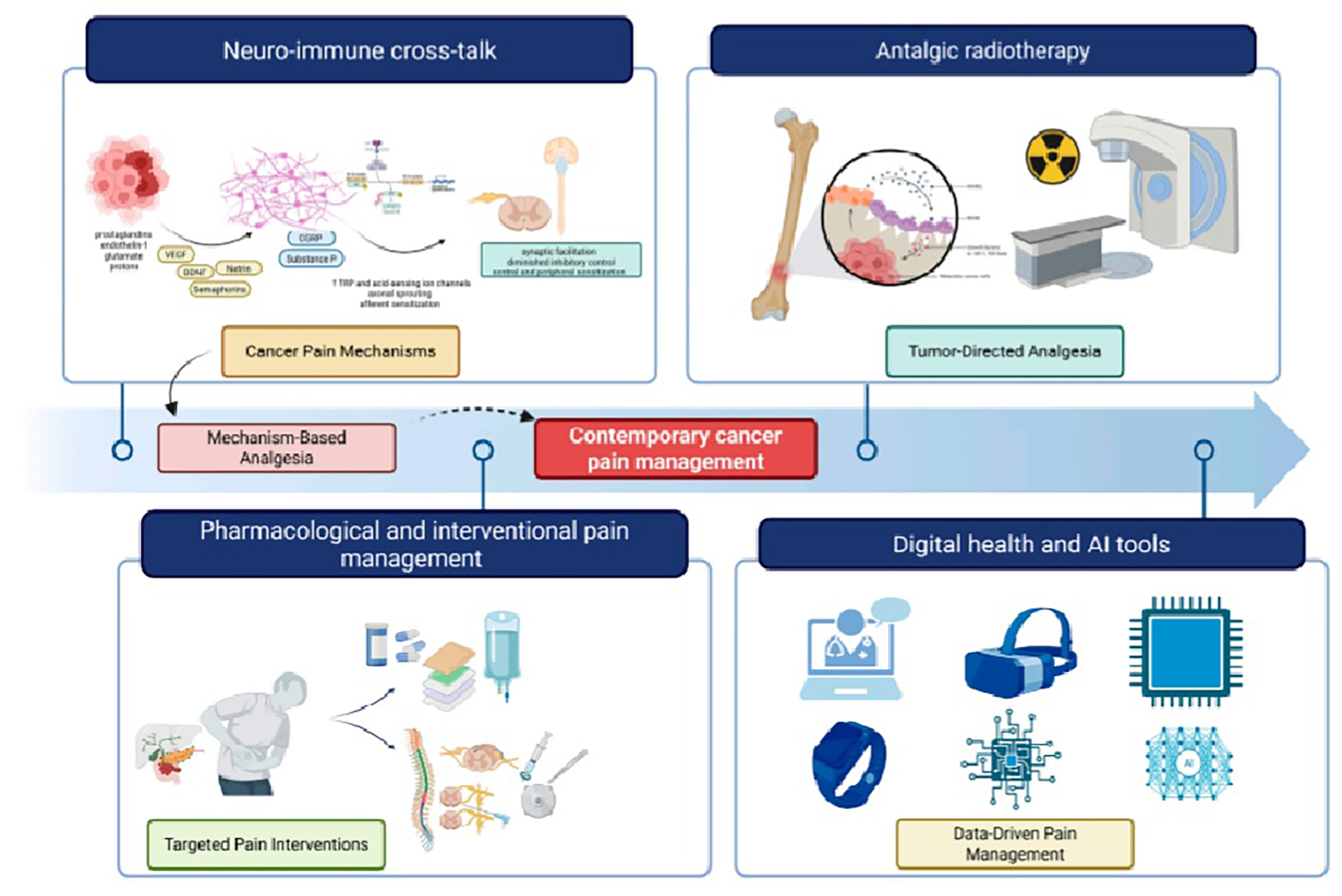
Results. Recent mechanistic research reveals cancer pain arises from tumor–neuron–immune crosstalk, with malignant cells secreting neurotrophic factors that promote axonal sprouting and nociceptor sensitization. Genetic polymorphisms and epigenetic modifications contribute to inter-individual pain variability. Management strategies are evolving toward multimodal precision medicine: NSAIDs and opioids remain foundational, complemented by adjuvant agents and interventional procedures, including nerve blocks, intrathecal delivery, and neuromodulation (spinal cord and dorsal root ganglion stimulation). Stereotactic body radiotherapy demonstrates superior analgesic durability versus conventional approaches. Digital health innovations, such as mobile applications, remote monitoring, wearables, and AI-enabled predictive models, enable continuous assessment and personalized treatment optimization.
Conclusions. Cancer pain management is transitioning toward mechanism-based precision medicine, integrating biological insights, advanced interventional techniques, and digital technologies. However, implementation challenges persist, including limited randomized trials for interventional approaches, the incomplete external validation of AI tools, and digital health equity concerns. Future research must prioritize prospective controlled studies and equitable integration into routine care.

Downloads
How to Cite

This work is licensed under a Creative Commons Attribution-NonCommercial 4.0 International License.
PAGEPress has chosen to apply the Creative Commons Attribution NonCommercial 4.0 International License (CC BY-NC 4.0) to all manuscripts to be published.