

 https://doi.org/10.4081/ahr.2025.127
Hyperspectral retinal imaging for micro- and nanoplastics detection: a conceptual and methodological framework
All claims expressed in this article are solely those of the authors and do not necessarily represent those of their affiliated organizations, or those of the publisher, the editors and the reviewers. Any product that may be evaluated in this article or claim that may be made by its manufacturer is not guaranteed or endorsed by the publisher.
Accepted: 3 December 2025
Published: 18 December 2025
This manuscript presents a conceptual and methodological framework rather than empirical results, outlining a pathway for applying hyperspectral retinal imaging (HSRI) to detect micro- and nanoplastics (MNPs). The retina, with its transparent optical media, layered architecture, and vascularization, offers an ideal biomedical model for adapting spectroscopic techniques that have been widely used in environmental and materials sciences. The framework consists of four staged phases: i) construction of a spectral library of common synthetic polymers; ii) phantom experiments that replicate retinal optical properties and are spiked with defined MNPs; iii) ex vivo validation in ocular tissues with Raman and Fourier-transform infrared spectroscopy as chemical ground truth; and iv) pilot in vivo studies in small-animal models to assess HSRI sensitivity, specificity, and safety. Machine-learning classifiers and spectral unmixing algorithms are incorporated to separate polymer-specific signals from endogenous chromophores such as hemoglobin, melanin, and lipofuscin. While no experimental data are presented, the framework anticipates the establishment of polymer spectral libraries, demonstration of separable spectral signatures, and translational feasibility for detecting polymer deposits under safe irradiance conditions. If validated, HSRI could enable the retina to serve as a sentinel organ for systemic pollutant exposure, bridging ophthalmology, toxicology, and environmental health with spectroscopy.
______________________________________________________________________________________________________________________________________________________
Graphical Abstract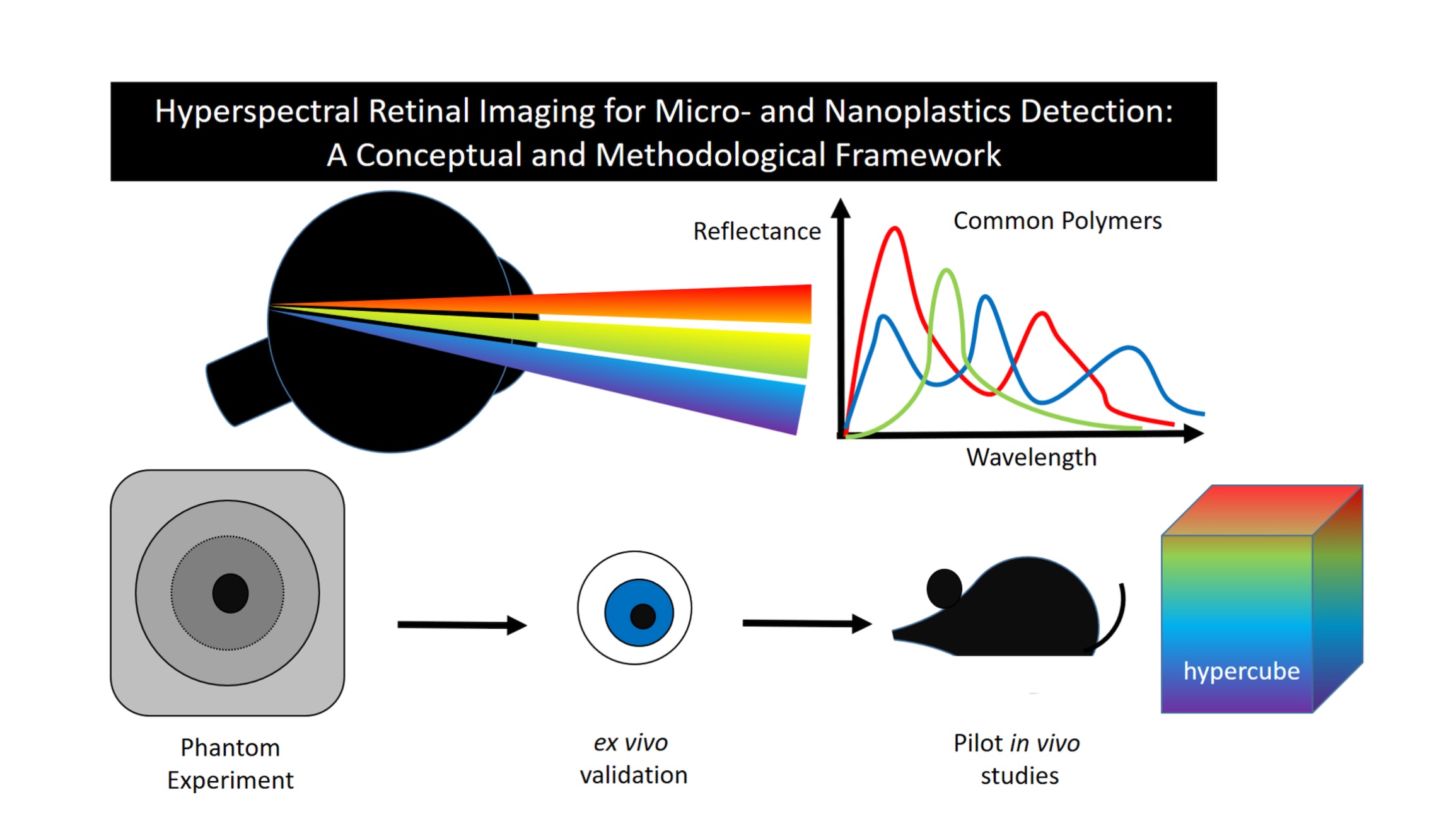
Downloads
1. Kadac-Czapska K, Ośko J, Knez E, Grembecka M. Microplastics and oxidative stress-current problems and prospects. Antioxidants 2024;13:579. DOI: https://doi.org/10.3390/antiox13050579
2. Bora SS, Gogoi R, Sharma MR, et al. Microplastics and human health: unveiling the gut microbiome disruption and chronic disease risks. Front Cell Infect Microbiol 2024;14:1492759. DOI: https://doi.org/10.3389/fcimb.2024.1492759
3. Gałęziewska J, Gromek P, Kruczkowska W, et al. Evaluating the relationship between microplastics and nanoplastics contamination and diverse cancer types development. Environ Pollut 2025;385:127052. DOI: https://doi.org/10.1016/j.envpol.2025.127052
4. Zhang K, Yu L, Qu L, et al. Identifying and analyzing the microplastics in human aqueous humor by pyrolysis-gas chromatography/mass spectrometry. iScience 2025;28:112078. DOI: https://doi.org/10.1016/j.isci.2025.112078
5. Zhong Y, Yang Y, Zhang L, et al. Revealing new insights: two-center evidence of microplastics in human vitreous humor and their implications for ocular health. Sci Total Environ 2024;921:171109. DOI: https://doi.org/10.1016/j.scitotenv.2024.171109
6. Kah TA. A Bayesian approach to investigating presumed retinal micro(nano)plastics. Biosystems 2025;253:105502. DOI: https://doi.org/10.1016/j.biosystems.2025.105502
7. Zhang M, Liu S, Wang Y, et al. Environmental science & technology letters. Environ Sci Technol Lett 2025;12:1327–33. DOI: https://doi.org/10.1021/acs.estlett.5c00903
8. Faltynkova A, Wagner M. Developing and testing a workflow to identify microplastics using near infrared hyperspectral imaging. Chemosphere 2023;336:139186. DOI: https://doi.org/10.1016/j.chemosphere.2023.139186
9. Zhang HJ, Zhou HR, Pan W, et al. Accumulation of nanoplastics in human cells as visualized and quantified by hyperspectral imaging with enhanced dark-field microscopy. Environ Int 2023;179:108134. DOI: https://doi.org/10.1016/j.envint.2023.108134
10. Saeed A, Hadoux X, van Wijngaarden P. Hyperspectral retinal imaging biomarkers of ocular and systemic diseases. Eye 2025;39:667-72. DOI: https://doi.org/10.1038/s41433-024-03135-9
11. Ng YB, Sung SF, Nguyen HT, et al. Amyloid beta biomarker for dementia detection by hyperspectral ophthalmoscope images. Aging 2024;16:13648-61. DOI: https://doi.org/10.18632/aging.206171
12. Karim S, Qadir A, Farooq U, et al. Hyperspectral imaging: a review and trends towards medical imaging. Curr Med Imaging 2022;19:417-27. DOI: https://doi.org/10.2174/1573405618666220519144358
13. Zhang X, Qiu J, Li X, et al. Complex refractive indices measurements of polymers in visible and near-infrared bands. Appl Opt 2020;59:2337-44. DOI: https://doi.org/10.1364/AO.383831
14. Lee H. Recent advances in simulation studies on the protein corona. Pharmaceutics 2024;16:1419. DOI: https://doi.org/10.3390/pharmaceutics16111419
15. Bashiri G, Padilla MS, Swingle KL, et al. Nanoparticle protein corona: from structure and function to therapeutic targeting. Lab Chip 2023;23:1432-66. DOI: https://doi.org/10.1039/D2LC00799A
16. Ntombela L, Adeleye B, Chetty N. Low-cost fabrication of optical tissue phantoms for use in biomedical imaging. Heliyon 2020;6:e03602. DOI: https://doi.org/10.1016/j.heliyon.2020.e03602
17. Kulmaganbetov M. Advancements in retinal tissue-mimicking optical coherence tomography phantoms: materials, properties, and applications. BioChem 2025;5:6. DOI: https://doi.org/10.3390/biochem5020006
18. Flock ST, Jacques SL, Wilson BC, et al. Optical properties of Intralipid: a phantom medium for light propagation studies. Lasers Surg Med 1992;12:510-9. DOI: https://doi.org/10.1002/lsm.1900120510
19. Ali JH, Bogdanovich S. Optical property measurements in normal human brain tissues: exploring discrepancies in the visible-NIR region. Biomed J Sci Tech Res 2023;51:008077. DOI: https://doi.org/10.26717/BJSTR.2023.51.008077
20. Nadithe V, Bae YH. Synthesis and characterization of hemoglobin conjugates with antioxidant enzymes via poly(ethylene glycol) cross-linker (Hb-SOD-CAT) for protection from free radical stress. Int J Biol Macromol 2010;47:603-13. DOI: https://doi.org/10.1016/j.ijbiomac.2010.08.007
21. Ghassemi P, Wang J, Melchiorri AJ, et al. Rapid prototyping of biomimetic vascular phantoms for hyperspectral reflectance imaging. J Biomed Opt 2015;20:121312. DOI: https://doi.org/10.1117/1.JBO.20.12.121312
22. Bryarly MD, Tran MH, Ali A, Fei B. Retina phantom model for hyperspectral imaging. Proc SPIE Int Soc Opt Eng 2025;13408:1340824. DOI: https://doi.org/10.1117/12.3048963
23. Alexander RG, Macknik SL, Martinez-Conde S. Microsaccade characteristics in neurological and ophthalmic disease. Front Neurol 2018;9:144. DOI: https://doi.org/10.3389/fneur.2018.00144
24. Pan MK. Targeting the fundamentals for tremors: the frequency and amplitude coding in essential tremor. J Biomed Sci 2025;32:18. DOI: https://doi.org/10.1186/s12929-024-01112-8
25. Clark AM, Intoy J, Rucci M, Poletti M. Eye drift during fixation predicts visual acuity. Proc Natl Acad Sci U S A 2022;119:e2200256119. DOI: https://doi.org/10.1073/pnas.2200256119
26. Kaluzny J, Li H, Liu W, et al. Bayer filter snapshot hyperspectral fundus camera for human retinal imaging. Curr Eye Res 2017;42:629–35. DOI: https://doi.org/10.1080/02713683.2016.1221976
27. Zhang J, Zhang Y, Qian M, Zhang X. Light consistency correction for the liquid crystal tunable filter hyperspectral imaging system. J Opt Soc Am A Opt Image Sci Vis 2024;41:1089-97. DOI: https://doi.org/10.1364/JOSAA.515706
28. Tran MH, Bryarly M, Pruitt K, et al. A high-resolution hyperspectral imaging system for the retina. Proc SPIE Int Soc Opt Eng 2024;12836:1283604. DOI: https://doi.org/10.1117/12.3001647
29. Delori FC, Webb RH, Sliney DH. American national standards institute. Maximum permissible exposures for ocular safety (ANSI 2000), with emphasis on ophthalmic devices. J Opt Soc Am A Opt Image Sci Vis 2007;24:1250-65. DOI: https://doi.org/10.1364/JOSAA.24.001250
30. Zhao J, Lan R, Tan H, et al. Detection and characterization of microplastics and nanoplastics in biological samples. Nat Rev Bioeng 2025;3:1019-33. DOI: https://doi.org/10.1038/s44222-025-00335-0
31. Nihart AJ, Garcia MA, El Hayek E, et al. Bioaccumulation of microplastics in decedent human brains. Nat Med 2025;31:1114-9. DOI: https://doi.org/10.1038/s41591-024-03453-1
32. Salvia R, Cañaveras M, Rico LG, et al. Prospective investigation of nanoplastic accumulation in healthy subjects, autoimmune diseases, hematological malignancies, lung cancer, and murine models. Microplastics 2025;4:1. DOI: https://doi.org/10.3390/microplastics4010001
33. Yong CQY, Valiyaveettil S, Tang BL. Toxicity of microplastics and nanoplastics in mammalian systems. Int J Environ Res Public Health 2020;17:1509. DOI: https://doi.org/10.3390/ijerph17051509
34. Jurowski K, Noga M, Kobylarz D, et al. Multimodal imaging using Raman spectroscopy and FTIR in a single analytical instrument with a microscope (infrared Raman microscopy AIRsight, Shimadzu): opportunities and applications. Int J Mol Sci 2024;25:6884. DOI: https://doi.org/10.3390/ijms25136884
35. Hermabessiere L, Himber C, Boricaud B, et al. Optimization, performance, and application of a pyrolysis-GC/MS method for the identification of microplastics. Anal Bioanal Chem 2018;410:6663-76. DOI: https://doi.org/10.1007/s00216-018-1279-0
36. Shi B, Patel M, Yu D, et al. Automatic quantification and classification of microplastics in scanning electron micrographs via deep learning. Sci Total Environ 2022;825:153903. DOI: https://doi.org/10.1016/j.scitotenv.2022.153903
37. Friebel M, Roggan A, Müller G, Meinke M. Determination of optical properties of human blood in the spectral range 250 to 1100 nm. J Biomed Opt 2006;11:034021. DOI: https://doi.org/10.1117/1.2203659
38. Zonios G, Dimou A, Bassukas I, et al. Melanin absorption spectroscopy: new method for noninvasive skin investigation and melanoma detection. J Biomed Opt 2008;13:014017. DOI: https://doi.org/10.1117/1.2844710
39. Mizushima M, Kawamura T, Takahashi K, Nitta K. In situ near-infrared spectroscopic studies of the structural changes of polyethylene during melting. Polym J 2012;44:162-6. DOI: https://doi.org/10.1038/pj.2011.100
40. Rasheed M, Moosad K, Nampoori PBV, Sathianandan K. Overtone spectra of styrene and polystyrene in the visible and near infrared regions. Pramana J Phys 1989;33:391-5. DOI: https://doi.org/10.1007/BF02845830
41. Jackson RS, Wang Q, Lien J. Data preprocessing method for the analysis of spectral components in mixtures. Appl Spectrosc 2022;76:81-91. DOI: https://doi.org/10.1177/00037028211042903
42. Rinnan Å, van den Berg F, Engelsen SB. Review of standard normal variate and other preprocessing methods. TrAC Trends Anal Chem 2009;28:1201-22. DOI: https://doi.org/10.1016/j.trac.2009.07.007
43. Campanale C, Massarelli C, Savino I, et al. A detailed review study on potential effects of microplastics and additives of concern on human health. Int J Environ Res Public Health 2020;17:1212. DOI: https://doi.org/10.3390/ijerph17041212
44. Shoup DN, Smith AE, Schultz ZD. Reduction of spectral overlap in spectral surface-enhanced Raman spectroscopy imaging using a dove prism. Appl Spectrosc 2025;79:2825–40. DOI: https://doi.org/10.1177/00037028251322540
45. Brazma A, Hingamp P, Quackenbush J, et al. Minimum information about a microarray experiment (MIAME)-toward standards for microarray data. Nat Genet 2001;29:365-71. DOI: https://doi.org/10.1038/ng1201-365
46. Nelson G, Boehm U, Bagley S, et al. QUAREP-LiMi: a community-driven initiative to establish guidelines for quality assessment and reproducibility for instruments and images in light microscopy. J Microsc 2021;284:56-73. DOI: https://doi.org/10.1111/jmi.13041
47. Rodrigues EM, Hemmer E. Trends in hyperspectral imaging: from environmental and health sensing to structure-property and nano-bio interaction studies. Anal Bioanal Chem 2022;414:4269-79. DOI: https://doi.org/10.1007/s00216-022-03959-y
48. El-Mahrouk M, Langner C, Sucher R, Kniepeiss D. Introducing hyperspectral imaging as a novel tool for assessing donor liver quality during machine perfusion: a case report. World J Transplant 2025;15:102798. DOI: https://doi.org/10.5500/wjt.v15.i3.102798
49. Studier-Fischer A, Bressan M, Qasim A, et al. Spectral characterization of intraoperative renal perfusion using hyperspectral imaging and artificial intelligence. Sci Rep 2024;14:17262. DOI: https://doi.org/10.1038/s41598-024-68280-3
50. Moulla Y, Buchloh DC, Köhler H, et al. Hyperspectral imaging (HSI)-a new tool to estimate the perfusion of upper abdominal organs during pancreatoduodenectomy. Cancers 2021;13:2846. DOI: https://doi.org/10.3390/cancers13112846
51. Hu Q, Wang X, Jiang J, et al. Exploring the spectral prior for hyperspectral image super-resolution. IEEE Trans Image Process 2024;33:5260-72. DOI: https://doi.org/10.1109/TIP.2024.3460470
How to Cite

This work is licensed under a Creative Commons Attribution-NonCommercial 4.0 International License.
PAGEPress has chosen to apply the Creative Commons Attribution NonCommercial 4.0 International License (CC BY-NC 4.0) to all manuscripts to be published.