
 https://doi.org/10.4081/ahr.2026.131
A translational mathematical model linking systemic biomarkers to disease recurrence in diabetic macular edema: a proof-of-concept analysis
All claims expressed in this article are solely those of the authors and do not necessarily represent those of their affiliated organizations, or those of the publisher, the editors and the reviewers. Any product that may be evaluated in this article or claim that may be made by its manufacturer is not guaranteed or endorsed by the publisher.
Accepted: 3 February 2026
Published: 18 March 2026
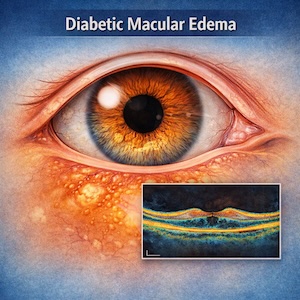
This study aimed to develop a translational mathematical model that links systemic biomarkers to diabetic macular edema (DME) dynamics and to provide a proof‑of‑concept assessment of its plausibility for informing anti‑vascular endothelial growth factor (anti‑VEGF) treatment strategies. A hybrid modeling approach was employed, combining mechanistic reasoning with a retrospective analysis of DRCR.net Protocol H data. A mechanistic model formalized the biological interaction between systemic drivers -glycated hemoglobin (HbA1c), systolic blood pressure (BP), and glycemic variability- and retinal VEGF dynamics, while an empirical penalty model translated these drivers into a framework for estimating personalized injection intervals (Imodel). Using data from 97 eyes treated with bevacizumab, we assessed the association between Imodel and a theoretical time to disease recurrence (Trec), defined as a >10% increase in central subfield thickness or a >5‑letter loss in visual acuity. The model’s hierarchical structure, which prioritized HbA1c, produced a shorter or equivalent interval compared to Trec in 63.6% of the overall cohort, and in a targeted subgroup where the model’s logic was fully applicable, the concordance rate was 77.6%. In Group E, simulating a post‑loading phase with two injections plus laser, the mean deviation between Imodel and Trec was minimal (-0.1 weeks) with reduced variability (SD=5.6 weeks). Sensitivity analysis confirmed the designed hierarchy, showing HbA1c exerted a 36‑fold greater influence on the model’s output than BP. These findings present a novel mathematical framework linking systemic metabolic and hemodynamic control to DME progression. The proof‑of‑concept analysis supports the biological plausibility of using HbA1c and BP to stratify recurrence risk and provides a transparent, interpretable foundation for future research. This model bridges systemic and ocular care and proposes a structured hypothesis for personalized treatment scheduling that warrants prospective validation in appropriately designed clinical cohorts.
Downloads
1. Nakao S, Kusuhara S, Murakami T. Anti-VEGF therapy for the long-term management of diabetic macular edema: a treat-to-target strategy based on macular morphology. Graefes Arch Clin Exp Ophthalmol 2024;262:3749-59. DOI: https://doi.org/10.1007/s00417-024-06558-y
2. Bhattacharya S, Kalra S, Nagendra L, Dutta D. Forty-four years of the UK Prospective Diabetes Study: legacy effect and beyond. touchREV Endocrinol 2025;21:2-3. DOI: https://doi.org/10.17925/EE.2025.21.1.8
3. Barnie A, Bott M, Farrell K, et al. Diabetes control and complications trial/Epidemiology of diabetes interventions and complications study DCCT/EDIC. Clinical Compendia 2024;2024:1-56. DOI: https://doi.org/10.2337/db2024-01
4. González P, Lozano P, Ros G, Solano F. Hyperglycemia and oxidative stress: an integral, updated and critical overview of their metabolic interconnections. Int J Mol Sci 2023;24:9352. DOI: https://doi.org/10.3390/ijms24119352
5. Benjamin LE. Glucose, VEGF-A, and diabetic complications. Am J Pathol 2021;158:1181-4. DOI: https://doi.org/10.1016/S0002-9440(10)64066-7
6. Beltramo E, Porta M. Pericyte loss in diabetic retinopathy: mechanisms and consequences. Curr Med Chem 2023;20:3218-25. DOI: https://doi.org/10.2174/09298673113209990022
7. Vidal-Oliver L, Herzig-de Almeida E, Spissinger S, Finger RP. Choriocapillaris flow deficit is associated with disease duration in type 2 diabetic patients without retinopathy: a cross-sectional study. Int J Retina Vitreous 2024;10:91. DOI: https://doi.org/10.1186/s40942-024-00611-y
8. Shah AR, Van Horn AN, Verchinina L, et al. Blood pressure is associated with receiving intravitreal anti-vascular endothelial growth factor treatment in patients with diabetes. Ophthalmol Retina 2019;3:410-6. DOI: https://doi.org/10.1016/j.oret.2019.01.019
9. Wong WM, Chee C, Bhargava M, et al. Systemic factors associated with treatment response in diabetic macular edema. J Ophthalmol 2020;2020:1875860. DOI: https://doi.org/10.1155/2020/1875860
10. Vorobyeva I, Frolov M, Kopylov P, Lomonosova A. Mathematical modeling of diabetic retinopathy with diabetic macular edema and primary open-angle glaucoma. In: Beskopylny A, Shamtsyan M, Artiukh V. (eds.), XV International Scientific Conference “INTERAGROMASH 2022”. INTERAGROMASH 2022. Lecture Notes in Networks and Systems, 2023:574. Springer, Cham. DOI: https://doi.org/10.1007/978-3-031-21432-5_317
11. Zhang J, Zhang J, Zhang C, et al. Diabetic macular edema: current understanding, molecular mechanisms and therapeutic implications. Cells 2022;11:3362. DOI: https://doi.org/10.3390/cells11213362
12. Khalid M, Petroianu G, Adem A. Advanced glycation end products and diabetes mellitus: mechanisms and perspectives. Biomolecules 2022;12:542. DOI: https://doi.org/10.3390/biom12040542
13. Zhang M, Wu J, Wang Y, et al. Associations between blood pressure levels and diabetic retinopathy in patients with diabetes mellitus: a population-based study. Heliyon 2023;9:e16830. DOI: https://doi.org/10.1016/j.heliyon.2023.e16830
14. Hsieh YT, Hsieh MC. Fasting plasma glucose variability is an independent risk factor for diabetic retinopathy and diabetic macular oedema in type 2 diabetes: an 8-year prospective cohort study. Clin Exp Ophthalmol. 2020;48:470-6. DOI: https://doi.org/10.1111/ceo.13728
15. Diabetic Retinopathy Clinical Research Network; Wells JA, Glassman AR, et al. Aflibercept, bevacizumab, or ranibizumab for diabetic macular edema. N Engl J Med 2015;372:1193-203. DOI: https://doi.org/10.1056/NEJMoa1414264
16. Rodríguez-Gutiérrez R, Millan-Alanis JM, Barrera FJ, McCoy RG. Value of patient-centered glycemic control in patients with type 2 diabetes. Curr Diab Rep 2021;21:63. DOI: https://doi.org/10.1007/s11892-021-01433-0
17. Lipman ML, Schiffrin EL. What is the ideal blood pressure goal for patients with diabetes mellitus and nephropathy? Curr Cardiol Rep 2012;14:651-9. DOI: https://doi.org/10.1007/s11886-012-0308-4
18. Martinez M, Santamarina J, Pavesi A, et al. Glycemic variability and cardiovascular disease in patients with type 2 diabetes. BMJ Open Diabetes Res Care 2021;9:e002032. DOI: https://doi.org/10.1136/bmjdrc-2020-002032
19. Stratton IM, Adler AI, Neil HA, et al. Association of glycaemia with macrovascular and microvascular complications of type 2 diabetes (UKPDS 35): prospective observational study. BM. 2000;321:405-12. DOI: https://doi.org/10.1136/bmj.321.7258.405
20. Angaramo S, Liu Y, Chen Q, Padovani-Claudio DA. Impact of hypertension severity on risk of diabetic macular edema development. Invest Ophthalmol Vis Sci 2021;62:1059.
21. Kavaric N, Klisic A, Ninic A. Cardiovascular risk estimated by UKPDS risk engine algorithm in diabetes. Open Med (Wars) 2018;13:610-7. DOI: https://doi.org/10.1515/med-2018-0086
22. Chew EY, Davis MD, Danis RP, et alThe effects of medical management on the progression of diabetic retinopathy in persons with type 2 diabetes: the Action to Control Cardiovascular Risk in Diabetes (ACCORD) Eye Study. Ophthalmology 2014;121:2443-51. DOI: https://doi.org/10.1016/j.ophtha.2014.07.019
23. Keech A, Simes RJ, Barter P, et al. Effects of long-term fenofibrate therapy on cardiovascular events in 9795 people with type 2 diabetes mellitus (the FIELD study): randomised controlled trial. Lancet 2005;366:1849-61. DOI: https://doi.org/10.1016/S0140-6736(05)67667-2
24. Baker CW, Glassman AR, Beaulieu WT, et al. Effect of initial management with aflibercept vs laser photocoagulation vs observation on vision loss among patients with diabetic macular edema involving the center of the macula and good visual acuity: a randomized clinical trial. JAMA 2019;321:1880-94. DOI: https://doi.org/10.1001/jama.2019.5790
25. Wykoff CC, Croft DE, Brown DM, et al. Prospective trial of treat and extend versus monthly dosing for neovascular age-related macular degeneration: TREX AMD 1 year results. Ophthalmology 2015;122:2514-22. DOI: https://doi.org/10.1016/j.ophtha.2015.08.009
26. Ciulla TA, Bracha P, Pollack J, Williams DF. Real-world outcomes of anti-vascular endothelial growth factor therapy in diabetic macular edema in the United States. Ophthalmol Retina 2018;2:1179-87. DOI: https://doi.org/10.1016/j.oret.2018.06.004
27. Liu S, Xu Q, Xu Z, et al. Reinforcement learning to optimize ventilator settings for patients on invasive mechanical ventilation: retrospective study. J Med Internet Res 2024;26:e44494. DOI: https://doi.org/10.2196/44494
28. Drori I, Zhang S, Shuttleworth R, et al. A neural network solves, explains, and generates university math problems by program synthesis and few-shot learning at human level. Proc Natl Acad Sci USA 2022;119:e2123433119. DOI: https://doi.org/10.1073/pnas.2123433119
29. Teo ZL, Jin L, Li S, et al. Federated machine learning in healthcare: a systematic review on clinical applications and technical architecture. Cell Rep Med. 2024;5:101419. DOI: https://doi.org/10.1016/j.xcrm.2024.101419
How to Cite

This work is licensed under a Creative Commons Attribution-NonCommercial 4.0 International License.
PAGEPress has chosen to apply the Creative Commons Attribution NonCommercial 4.0 International License (CC BY-NC 4.0) to all manuscripts to be published.