
 https://doi.org/10.4081/ahr.2026.166
OPIOID-SPARING EFFECT OF LIDOCAINE, KETAMINE AND MAGNESIUM IN THORACOTOMY
J. Herrera Silva1, S.T. Bahí2, M. Díaz2, I. Gascó2, C. Rodriguez3, X. Baldó3, M. Vives4 | 1Department of Anesthesia, Reanimation and Pain Unit, Dr. Bofill Clinic - University Hospital Dr. J. Trueta, Girona, Spain; 2Department of Anesthesia & Reanimation, Hospital Universitari Dr. J. Trueta, Girona, Spain; 3Department of Anesthesia & Thoracic Surgery, University Hospital Dr. J. Trueta, Girona, Spain; 4Department of Anesthesia & Critical Care Medicine, Clinica Universidad de Navarra, Pamplona, Spain; IdiSNA, Instituto de Investigación Sanitaria de Navarra, Spain
All claims expressed in this article are solely those of the authors and do not necessarily represent those of their affiliated organizations, or those of the publisher, the editors and the reviewers. Any product that may be evaluated in this article or claim that may be made by its manufacturer is not guaranteed or endorsed by the publisher.
Published: 6 May 2026
Background and Aims. Thoracotomy is associated with severe postoperative pain and high opioid requirements. Perioperative pain management increasingly prioritizes opioid-sparing strategies that maintain effective analgesia. This study evaluated whether intraoperative lidocaine–ketamine–magnesium (LKM) infusion reduces postoperative morphine consumption and pain intensity.
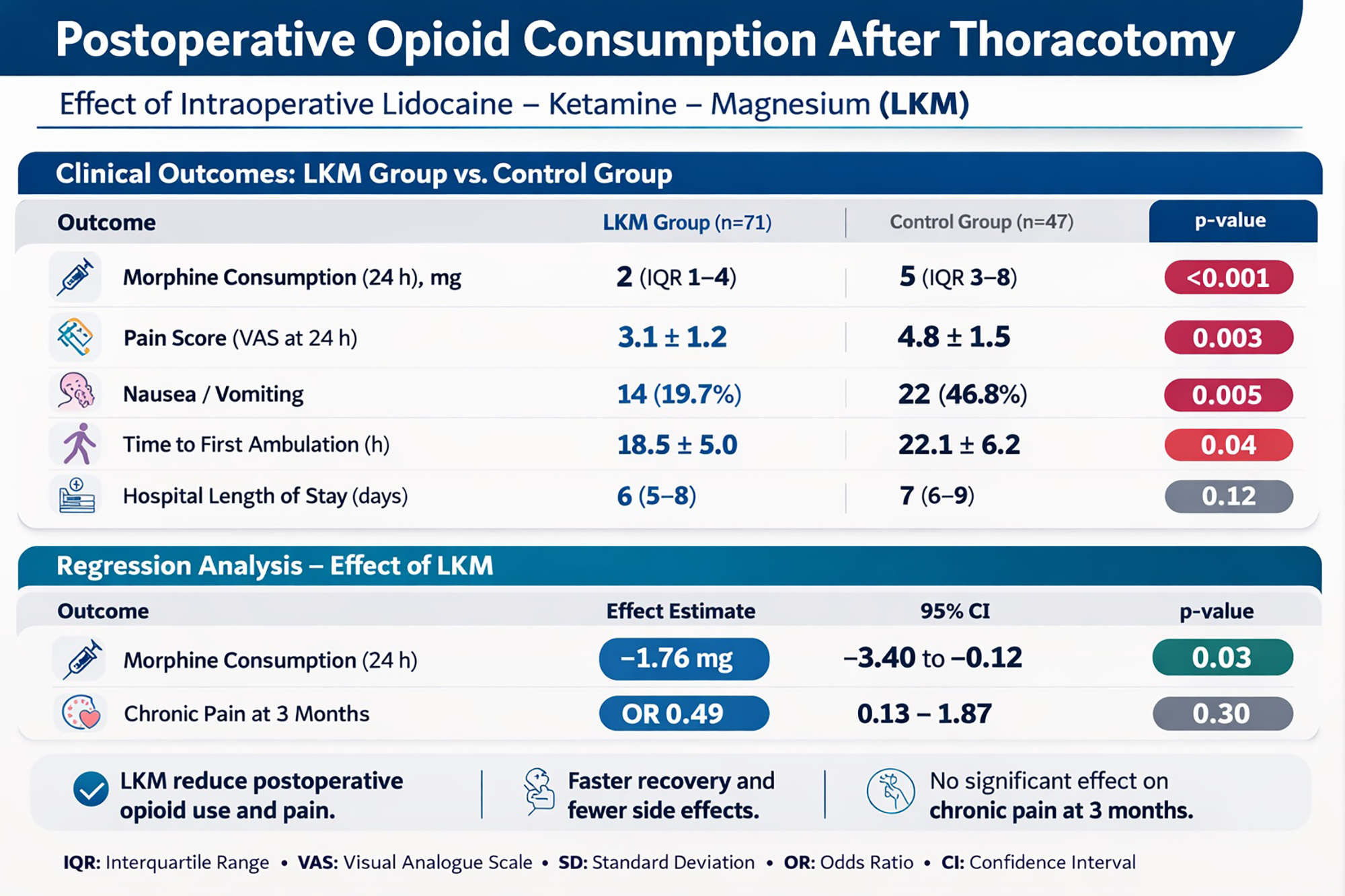
Methods. A prospective single-center observational study included 118 adult patients undergoing pulmonary resection via thoracotomy. Patients received either intraoperative LKM infusion as part of a multimodal analgesic protocol or standard perioperative analgesia. The primary outcome was cumulative morphine consumption during the first 24 postoperative hours. Secondary outcomes included pain intensity measured with the Visual Analogue Scale (VAS) at 3 and 24 hours, the prevalence of chronic pain at 3 months, and drug-related adverse events. Multivariable regression analysis assessed the independent association between LKM administration and morphine consumption.
Results. Morphine consumption during the first 24 postoperative hours was significantly lower in the LKM group compared with controls (median [IQR] 2 [0–6] mg vs. 5 [3–8] mg; p = 0.001), representing an approximate 60% reduction in morphine consumption. After multivariable adjustment, LKM administration remained independently associated with reduced morphine consumption (β = −1.76; 95% CI −3.40 to −0.12; p = 0.03). Pain scores were significantly lower at 3 and 24 hours postoperatively. No differences were observed in the prevalence of chronic pain at 3 months and no drug-related adverse events occurred.
Conclusions. Intraoperative lidocaine–ketamine–magnesium infusion improves early postoperative analgesia and reduces morphine consumption after thoracotomy. Further studies are needed to confirm these findings.
Downloads
How to Cite

This work is licensed under a Creative Commons Attribution-NonCommercial 4.0 International License.
PAGEPress has chosen to apply the Creative Commons Attribution NonCommercial 4.0 International License (CC BY-NC 4.0) to all manuscripts to be published.