
 https://doi.org/10.4081/ahr.2026.149
BEYOND ANALGESIA: FASCIAL PLANE BLOCKS AS MODULATORS OF THE SURGICAL STRESS RESPONSE
C. Angeletti, I. Olivieri, G. Di Giuseppe, G. Varrassi | Department of Anesthesia, Intensive Care and Pain Medicine, Mazzini Hospital, Teramo, Italy
All claims expressed in this article are solely those of the authors and do not necessarily represent those of their affiliated organizations, or those of the publisher, the editors and the reviewers. Any product that may be evaluated in this article or claim that may be made by its manufacturer is not guaranteed or endorsed by the publisher.
Published: 6 May 2026
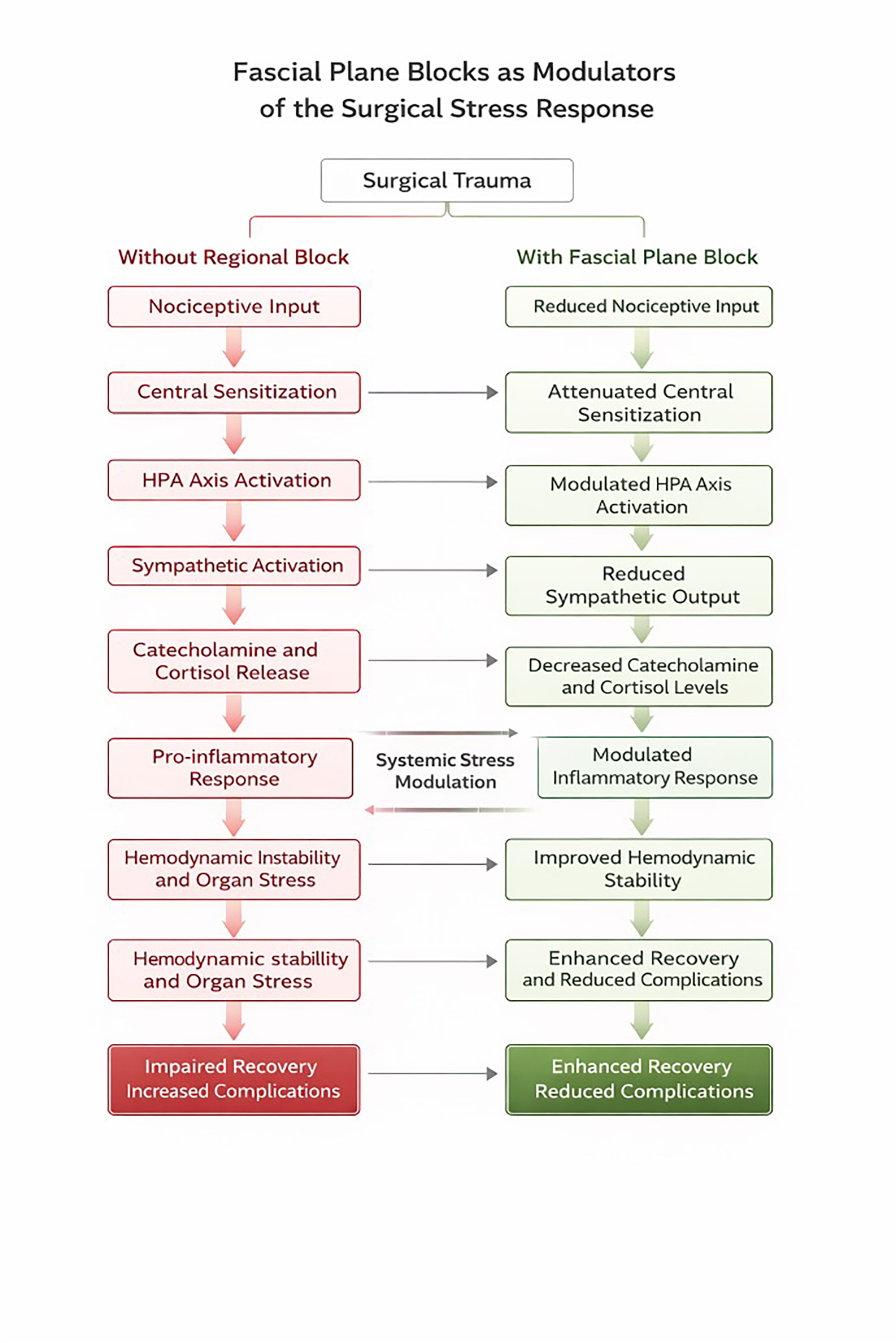
Background and Aims. Fascial plane blocks are increasingly used as part of multimodal analgesia in perioperative care. While traditionally seen only as pain-relief techniques, their ability to influence the systemic stress response to surgery is still not well understood. Surgical trauma triggers a complex neuroendocrine and inflammatory response, involving sympathetic activation, hypothalamic–pituitary–adrenal (HPA) axis activation, and cytokine release, all of which can affect postoperative recovery and organ function. To create a clinically relevant framework that views fascial plane blocks as modulators of the surgical stress response, beyond their role in pain relief.
Methods. We conducted a narrative, mechanism-based review that integrates current evidence on regional anesthesia, autonomic modulation, and perioperative stress physiology, with a focus on fascial plane techniques.
Results. By reducing nociceptive input at its source, fascial plane blocks may decrease central sensitization and limit activation of stress-related pathways. This could result in lower sympathetic output, better autonomic balance, and decreased neuroendocrine activation. Emerging evidence suggests potential downstream effects, including reduced catecholamine release, modulation of inflammatory responses, improved hemodynamic stability, and decreased opioid requirements. These mechanisms may help enhance recovery, reduce complication rates, and improve patient-centered outcomes. However, current data are heterogeneous and largely indirect, with few studies specifically evaluating systemic effects.
Conclusions. Fascial plane blocks should be viewed not only as pain management tools but also as potential modulators of the surgical stress response. Adopting a broader physiological perspective can facilitate their incorporation into strategies to improve perioperative resilience and recovery.

Downloads
How to Cite

This work is licensed under a Creative Commons Attribution-NonCommercial 4.0 International License.
PAGEPress has chosen to apply the Creative Commons Attribution NonCommercial 4.0 International License (CC BY-NC 4.0) to all manuscripts to be published.