

 https://doi.org/10.4081/ahr.2026.144
Virtual reality as a treatment for acute antiemetic-induced akathisia
All claims expressed in this article are solely those of the authors and do not necessarily represent those of their affiliated organizations, or those of the publisher, the editors and the reviewers. Any product that may be evaluated in this article or claim that may be made by its manufacturer is not guaranteed or endorsed by the publisher.
Accepted: 12 May 2026
Published: 21 May 2026
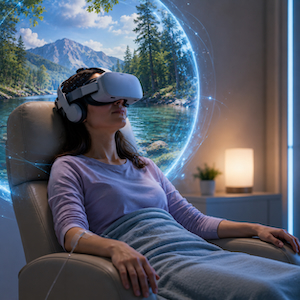
Many patients receiving common antiemetic medications for a variety of complaints ranging from gastroenteritis to headache to surgery experience the distressing extra-pyramidal neuropsychiatric side effect of akathisia due to the dopamine-antagonist mechanism of these drugs. Akathisia involves a persistent restlessness and urge to move, common in those taking antiemetics. Currently, a literature gap exists surrounding how virtual reality (VR) often used for general mental health treatment can be leveraged in a biosensor capacity toward neurotransmitter analysis and balancing among patients experiencing antiemetic-induced akathisia. This review examined the potential benefits of wearable VR technology as a non-pharmacological treatment solution for patients displaying signs of akathisia in an acute setting such as the emergency department. The review concluded with a Python code foundation for two machine learning algorithms for a wearable biosensor to correlate neurochemical fluctuations of dopamine and stress-induced cortisol with VR audiovisual inputs among patients with akathisia stemming from these drugs. Potential obstacles included the risk of invasiveness implicated by administration of neurotransmitter saliva tests among wearers experiencing these stressful symptoms as well as the technical challenge of integrating biosensing capabilities into a virtual reality wearable device.
Downloads
1. Cleveland Clinic [Internet]. Akathisia: What it is, symptoms, causes & treatment. 2002. Available from: https://my.clevelandclinic.org/health/diseases/23954-akathisia
2. Moraes ACN, Wijaya C, Freire R, et al. Neurochemical and genetic factors in panic disorder: a systematic review. Transl Psychiatry 2024;14:294. DOI: https://doi.org/10.1038/s41398-024-02966-0
3. McAllister R. Top 10 conditions that lead to ER Visits in the U.S. for 2025 - North American Community Hub. 2025. Available from: https://nchstats.com/conditions-that-lead-to-er-visits
4. Meyer J, Kirkland SW, Campbell S, et al. Adjuvant anticholinergic therapy for the prevention of akathisia in patients with primary headache in the emergency department: a systematic review. Acad Emerg Med 2023;30:45-52. DOI: https://doi.org/10.1111/acem.14581
5. Nagaoka K, Nagayasu K, Shirakawa H, Kaneko S. Acetaminophen improves tardive akathisia induced by dopamine D2 receptor antagonists. J Pharmacol Sci 2023;151:9-16. DOI: https://doi.org/10.1016/j.jphs.2022.10.006
6. Hosseinzadeh B, Cetinkaya A, Bellur Atici E, Ozkan SA. Detection of the antipsychotic drug cariprazine using a low-cost MIP-based electrochemical sensor and its electrooxidation behaviour. Microchem Jl 2024;207:112105. DOI: https://doi.org/10.1016/j.microc.2024.112105
7. Chinn E, Brunette DN, Driver BE, et al. Comparison of efficacy and frequency of akathisia and dystonia between olanzapine, metoclopramide and prochlorperazine in ED headache patients. Am J Emerg Med 2023;65:109-12. DOI: https://doi.org/10.1016/j.ajem.2022.12.039
8. Athavale A Athavale T Roberts DM. Antiemetic drugs: what to prescribe and when. Aust Prescr 2020;43:49-56. DOI: https://doi.org/10.18773/austprescr.2020.011
9. Du Plessis J, Jordaan J The impact of virtual reality on the psychological well-being of hospitalised patients: A critical review. Heliyon 2024;10:e24831. DOI: https://doi.org/10.1016/j.heliyon.2024.e24831
10. Chen G, Guo Z, Chen P, et al. Bright light therapy-induced improvements of mood, cognitive functions and cerebellar functional connectivity in subthreshold depression: A randomized controlled trial. Int J Clin Health Psychol 2024;24:100483. DOI: https://doi.org/10.1016/j.ijchp.2024.100483
11. Mevlevioğlu D, Tabirca S, Murphy D. Real-time classification of anxiety in virtual reality therapy using biosensors and a convolutional neural network. Biosensors 2024;14:131. DOI: https://doi.org/10.3390/bios14030131
12. Drotts DL, Vinson DR. Prochlorperazine induces akathisia in emergency patients. Ann Emerg Med 1999;34:469-75. DOI: https://doi.org/10.1016/S0196-0644(99)80048-1
13. Kritikos I Alevizopoulos G, Koutsouris D. Personalized virtual reality human-computer interaction for psychiatric and neurological illnesses: a dynamically adaptive virtual reality environment that changes according to real-time feedback from electrophysiological signal responses. Front Hum Neurosci. 2021;15:596980. DOI: https://doi.org/10.3389/fnhum.2021.596980
14. Dong F, Sefcik JS, Euiler E, Hodgson NA. Measuring salivary cortisol in biobehavioral research: A systematic review and methodological considerations. Brain Behav Immun Health 2005;43:100936. DOI: https://doi.org/10.1016/j.bbih.2024.100936
15. Weibel RP, Kerr JI, Naegelin M, et al. Virtual reality-supported biofeedback for stress management: Beneficial effects on heart rate variability and user experience. Comput Hum Behav 2023;141:107607. DOI: https://doi.org/10.1016/j.chb.2022.107607
16. Chiossi F, Ou C, Gerhardt C, et al. designing and evaluating an adaptive virtual reality system using EEG frequencies to balance internal and external attention states. Int J Hum Comput Stud 2025;196:103433. DOI: https://doi.org/10.1016/j.ijhcs.2024.103433
17. Santonocito R, Cavallaro A, Pappalardo A, et al. Detection of human salivary stress biomarkers using an easy-to-use array sensor based on fluorescent organic molecules. Biosens Bioelectron 2025;270:116986. DOI: https://doi.org/10.1016/j.bios.2024.116986
18. Sheng A, Lin L, Zhu J, et al. Micro/nanodevices for assessment and treatment in stomatology and ophthalmology. Microsyst Nanoeng 2021;7:11. DOI: https://doi.org/10.1038/s41378-021-00238-1
19. Silva LRG, Stefano JS, Orzari LO, et al. Electrochemical biosensor for SARS-CoV-2 cDNA detection using AuPs-Modified 3D-printed graphene electrodes. Biosensors 2022;12:622. DOI: https://doi.org/10.3390/bios12080622
20. Roppolo LP, MorrisWD, Khan F, et al. Improving the management of acutely agitated patients in the emergency department through implementation of Project BETA (Best Practices in the Evaluation and Treatment of Agitation). J Am Coll Emerg Physicians Open 2020;1:898-907. DOI: https://doi.org/10.1002/emp2.12138
21. Goring SA, Gray ED, Miller EL, Brunyé TT. Salivary biosensing opportunities for predicting cognitive and physical human performance. Biosensors 2025;15:418. DOI: https://doi.org/10.3390/bios15070418
22. Bai Y, Li C, Wang F, et al. Smart flexible wearables for non-invasive body fluid monitoring: a multidisciplinary roadmap and future directions. Sens Actuators Rep 2025;10:100380. DOI: https://doi.org/10.1016/j.snr.2025.100380
23. Walters AS, Hening A. Opioids a better treatment for acute than tardive akathisia: possible role for the endogenous opiate system in neuroleptic-induced akathisia. Med Hypotheses 1989;28:1-2. DOI: https://doi.org/10.1016/0306-9877(89)90145-X
How to Cite

This work is licensed under a Creative Commons Attribution-NonCommercial 4.0 International License.
PAGEPress has chosen to apply the Creative Commons Attribution NonCommercial 4.0 International License (CC BY-NC 4.0) to all manuscripts to be published.