

 https://doi.org/10.4081/ahr.2026.132
Postoperative respiratory depression and pulmonary complications: serious but underappreciated
All claims expressed in this article are solely those of the authors and do not necessarily represent those of their affiliated organizations, or those of the publisher, the editors and the reviewers. Any product that may be evaluated in this article or claim that may be made by its manufacturer is not guaranteed or endorsed by the publisher.
Published: 17 April 2026
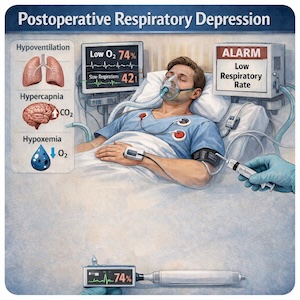
Postoperative pulmonary complications represent one of the most consequential but underappreciated sources of peri- and post-operative morbidity and mortality. Among these, postoperative respiratory depression, characterized by inadequate ventilatory drive, hypoxemia, and hypercapnia following anesthesia and surgery, has emerged as a subtle, but serious threat to patient safety.
Downloads
1. Fernandez-Bustamante A, Frendl G, Sprung J, et al. Postoperative pulmonary complications, early mortality, and hospital stay following noncardiothoracic surgery: a multicenter study by the perioperative research network investigators. JAMA Surg 2017;152:157-66. DOI: https://doi.org/10.1001/jamasurg.2016.4065
2. Miskovic A, Lumb Ab. Postoperative pulmonary complications. Br J Anaesth 2017;118:317-34. DOI: https://doi.org/10.1093/bja/aex002
3. Raffa RB, Pergolizzi JV, Jr., Dungan GC, Miller TL. Mortality 30, 60, and 90 days after discharge is greater in patients who experienced postoperative respiratory depression and pulmonary complication. Cureus 2025;17:e79913. DOI: https://doi.org/10.7759/cureus.79913
4. Overdyk FJ, Carter R, Maddox RR, et al. Continuous oximetry/capnometry monitoring reveals frequent desaturation and bradypnea during patient-controlled analgesia. Anesth Analg 2007;105:412-8. DOI: https://doi.org/10.1213/01.ane.0000269489.26048.63
5. Neto AS, Da Costa LGV, Hemmes SNT, et al. The LAS VEGAS risk score for prediction of postoperative pulmonary complications: an observational study. Eur J Anaesthesiol 2018;35:691-701. DOI: https://doi.org/10.1097/EJA.0000000000000845
6. Lam T, Nagappa M, Wong J, et al. Continuous pulse oximetry and capnography monitoring for postoperative respiratory depression and adverse events: a systematic review and meta-analysis. Anesth Analg 2017;125:2019-29. DOI: https://doi.org/10.1213/ANE.0000000000002557
7. Dahan A, Aarts L, Smith Tw. Incidence, reversal, and prevention of opioid-induced respiratory depression. Anesthesiology 2010;112:226-38. DOI: https://doi.org/10.1097/ALN.0b013e3181c38c25
8. Murphy GS, Szokol JW, Marymont JH, et al. Intraoperative acceleromyographic monitoring reduces the risk of residual neuromuscular blockade and adverse respiratory events in the postanesthesia care unit. Anesthesiology 2008;109:389-98. DOI: https://doi.org/10.1097/ALN.0b013e318182af3b
9. Lumb AB, Slinger P. Hypoxic pulmonary vasoconstriction: physiology and anesthetic implications. Anesthesiology 2015;122:932-46. DOI: https://doi.org/10.1097/ALN.0000000000000569
10. Chughtai M, Gwam Cu, Mohamed N, et al. The epidemiology and risk factors for postoperative pneumonia. J Clin Med Res 2017;9:466-75. DOI: https://doi.org/10.14740/jocmr3002w
11. Sabate S, Mazo V, Canet J. Predicting postoperative pulmonary complications: implications for outcomes and costs. Curr Opin Anaesthesiol 2014;27:201-9. DOI: https://doi.org/10.1097/ACO.0000000000000045
12. Taenzer AH, Pyke JB, McGrath SP, Blike GT. Impact of pulse oximetry surveillance on rescue events and intensive care unit transfers: a before-and-after concurrence study. Anesthesiology 2010;112:282-7. Erratum in: Anesthesiology 2020;132:602. DOI: https://doi.org/10.1097/ALN.0b013e3181ca7a9b
13. Ljungqvist O, Scott M, Fearon KC. Enhanced recovery after surgery: a review. JAMA Surg 2017;152:292-8. DOI: https://doi.org/10.1001/jamasurg.2016.4952
How to Cite

This work is licensed under a Creative Commons Attribution-NonCommercial 4.0 International License.
PAGEPress has chosen to apply the Creative Commons Attribution NonCommercial 4.0 International License (CC BY-NC 4.0) to all manuscripts to be published.