
National Conference of the Italian Association for the Study of Pain
Vol. 3 No. s2 (2026): 49th National Conference of the Italian Association for the Study of Pain
 https://doi.org/10.4081/ahr.2026.293
IMPLEMENTATION OF A HUB PROTOCOL FOR REDUCING COMPLICATIONS IN SPINAL CORD AND DORSAL ROOT GANGLION STIMULATION: REAL-WORLD EXPERIENCE FROM THE EASTERN SICILY PAIN MANAGEMENT HUB CENTER
S. Zappalà1, S. Stimolo2, M. Maria3, S. Brundo3, S. Caramma3 | 1Università di padova, Padova, Italy; 2Università di Padova, Italy; 3Policlinico G. Rodolico- San Marco, Catania, Italy
Publisher's note
All claims expressed in this article are solely those of the authors and do not necessarily represent those of their affiliated organizations, or those of the publisher, the editors and the reviewers. Any product that may be evaluated in this article or claim that may be made by its manufacturer is not guaranteed or endorsed by the publisher.
All claims expressed in this article are solely those of the authors and do not necessarily represent those of their affiliated organizations, or those of the publisher, the editors and the reviewers. Any product that may be evaluated in this article or claim that may be made by its manufacturer is not guaranteed or endorsed by the publisher.
Received: 21 September 2026
Published: 21 September 2026
Published: 21 September 2026
0
Views
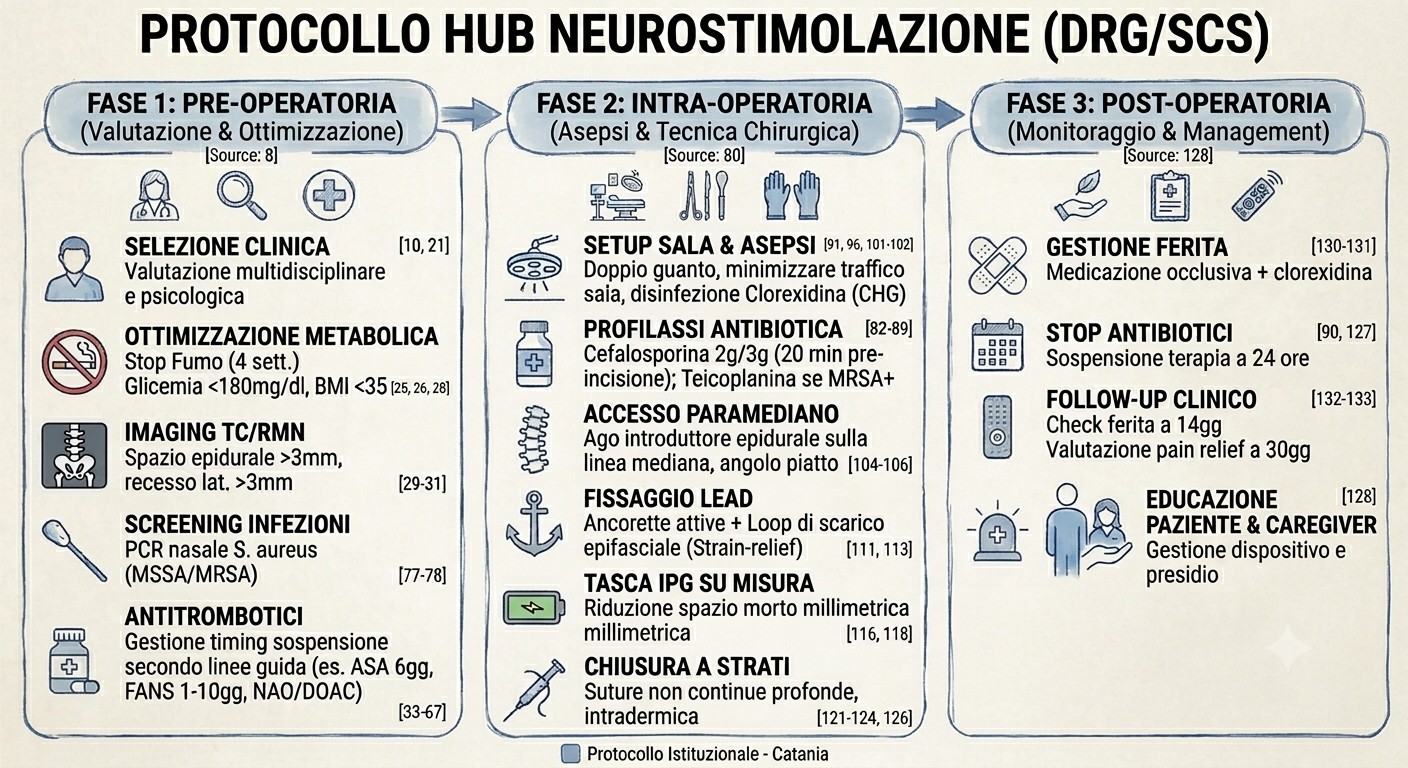
Methods. A retrospective observational study (January 2024–June 2025) evaluated 66 patients undergoing definitive SCS/DRGS implantation after a 30-day trial phase with >50% pain relief. The institutional protocol standardized three main phases: Pre-operative Phase Comprehensive clinical assessment, including psychological and functional evaluation for clinical eligibility , metabolic optimization (fasting glucose <180 mg/dl, smoking cessation ≥ 4 weeks, BMI <35). Neuroanatomical eligibility via CT/MRI required a posterior epidural space and lateral recess width >3 mm. Antithrombotic therapy was managed per NACC/INS guidelines, alongside S. aureus nasal PCR screening and antiseptic showers. Intra-operative & Surgical Phase: Antibiotic prophylaxis, chlorhexidine skin antisepsis, and a double-glove technique before handling the implantable pulse generator (IPG). Leads were placed fluoroscopically via a paramedian epidural approach. Device stability was secured using active anchors, deep fascial silk sutures, and an epifascial strain-relief loop. The IPG pocket was tailored precisely to eliminate dead spaces, followed by layered anatomical closure (deep interrupted and intradermal sutures). Post-operative Phase: Wound care, patient/caregiver education, and clinical/telemetric follow-ups at 7, 14, 21, and 30 days (definitive implant, T1), 3 months (T2), 6 months (T3), and 1 year (T4).
Results. The cumulative 1-year (T4) complication rate was 3.03% (n=2/66). Both superficial and deep surgical site infections were 0%, showing a statistically significant reduction compared to historical data (p<0.05). Neurological, hemorrhagic, and CSF leak complications were also 0%. Adverse events were exclusively mechanical (3.03%, n=2): one DRGS electrode fracture at T3 due to trauma, and one SCS lead migration at T4 following a domestic accident. The rate of intrinsic complications directly attributable to failures in the standardized clinical pathway was 0%.
Conclusions. Systematic application of an evidence-based, standardized HUB protocol eliminates clinical variability, reducing intrinsic procedural complications to near-zero levels while maximizing patient safety and healthcare efficiency.
Downloads
Download data is not yet available.
1. Deer T.R., et al. The Neurostimulation Appropriateness Consensus Committee (NACC)®: Recommendations for the Mitigation of Complications of Neurostimulation. Neuromodulation 2024; 27: 977–1007.
2. Deer T.R., et al. The Neurostimulation Appropriateness Consensus Committee (NACC): Recommendations for Surgical Technique for Spinal Cord Stimulation. Neuromodulation 2022; 25: 1–34.
How to Cite
1.
IMPLEMENTATION OF A HUB PROTOCOL FOR REDUCING COMPLICATIONS IN SPINAL CORD AND DORSAL ROOT GANGLION STIMULATION: REAL-WORLD EXPERIENCE FROM THE EASTERN SICILY PAIN MANAGEMENT HUB CENTER: S. Zappalà1, S. Stimolo2, M. Maria3, S. Brundo3, S. Caramma3 | 1Università di padova, Padova, Italy; 2Università di Padova, Italy; 3Policlinico G. Rodolico- San Marco, Catania, Italy. Adv Health Res [Internet]. 2026 Sep. 21 [cited 2026 Sep. 29];3(s2). Available from: https://www.ahr-journal.org/site/article/view/293
Copyright (c) 2026 The Author(s)


This work is licensed under a Creative Commons Attribution-NonCommercial 4.0 International License.
PAGEPress has chosen to apply the Creative Commons Attribution NonCommercial 4.0 International License (CC BY-NC 4.0) to all manuscripts to be published.