
National Conference of the Italian Association for the Study of Pain
Vol. 3 No. s2 (2026): 49th National Conference of the Italian Association for the Study of Pain
 https://doi.org/10.4081/ahr.2026.291
VAGAL NEUROMODULATION FOR DRUG-RESISTANT TRIGEMINAL NEURALGIA: A CASE SERIES
C. Tuccillo1, A.M. Salzano2, M.T. Di Dato2, A. Diana1, C. Morrone1, M.B. Passavanti3, C. Pace3, E. Saracco2, M.V. Adriani2, P. Mango2, D. Tammaro2, A. Papa2 | 1Residency Program in Anesthesiology, Resuscitation, Intensive and Pain Therapy University of Campania "Luigi Vanvitelli", Napoli, Italy; 2Pain Department, A.O. Dei Colli - V. Monaldi Hospital, Napoli, Italy; 3Department of Women, Child and General and Specialized Surgery, University of Campania "Luigi Vanvitelli", Napoli, Italy
Publisher's note
All claims expressed in this article are solely those of the authors and do not necessarily represent those of their affiliated organizations, or those of the publisher, the editors and the reviewers. Any product that may be evaluated in this article or claim that may be made by its manufacturer is not guaranteed or endorsed by the publisher.
All claims expressed in this article are solely those of the authors and do not necessarily represent those of their affiliated organizations, or those of the publisher, the editors and the reviewers. Any product that may be evaluated in this article or claim that may be made by its manufacturer is not guaranteed or endorsed by the publisher.
Received: 21 September 2026
Published: 21 September 2026
Published: 21 September 2026
0
Views
Methods. Four patients with chronic TN were enrolled in a case series (two men, two women; aged 40–70 years) with a history of TN lasting over two years and severe pain (Numerical Rating Scale [NRS] = 10/10) despite ongoing treatment with NSAIDs, triptans, and opioids. Patients underwent non-invasive VNS for six consecutive weeks: the device was placed in the retroauricular region weekly, alternating sides. Clinical assessments were performed weekly to evaluate pain intensity (NRS), treatment response, tolerability, and adverse events. The primary outcome was pain reduction after six weeks.
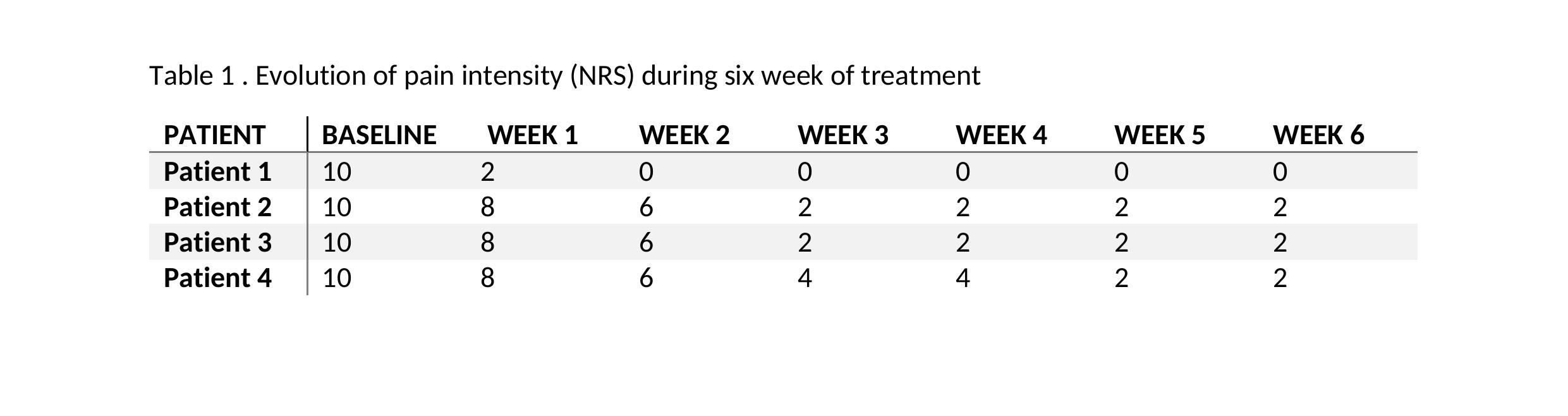
Results. All patients completed the six-week protocol. At baseline, pain intensity was 10/10 on the NRS. Following retroauricular VNS, all patients experienced a progressive reduction in pain. Mean NRS scores decreased steadily until week six, when one patient achieved a score of 0 and the others a score of 2 (Table 1). The most marked improvement occurred during the first three weeks, followed by stabilization. No patient experienced worsening of symptoms or discontinued treatment, suggesting a cumulative therapeutic effect. The intervention was well tolerated; mild, transient dizziness reported during the first week resolved spontaneously. No serious adverse events occurred.
Conclusions. Retroauricular VNS was associated with substantial and progressive pain reduction in patients with long-standing, drug-resistant TN. All patients achieved significant pain relief with only mild, transient side effects. These findings suggest that retroauricular VNS may represent a safe, effective, non-invasive therapeutic option for refractory TN, supporting further investigation in larger controlled studies.
Downloads
Download data is not yet available.
1. Bendtsen L, et al. European Academy of Neurology guideline on trigeminal neuralgia. Eur J Neurol. 2019;26(6):831–849.
2. Yuan H, Silberstein SD. Vagus nerve and vagus nerve stimulation: Part III. Headache. 2016;56(3):479–490.
3. Johnson RL, Wilson CG. A review of vagus nerve stimulation as a therapeutic intervention. J Inflamm Res. 2018;11:203–213.
How to Cite
1.
VAGAL NEUROMODULATION FOR DRUG-RESISTANT TRIGEMINAL NEURALGIA: A CASE SERIES: C. Tuccillo1, A.M. Salzano2, M.T. Di Dato2, A. Diana1, C. Morrone1, M.B. Passavanti3, C. Pace3, E. Saracco2, M.V. Adriani2, P. Mango2, D. Tammaro2, A. Papa2 | 1Residency Program in Anesthesiology, Resuscitation, Intensive and Pain Therapy University of Campania "Luigi Vanvitelli", Napoli, Italy; 2Pain Department, A.O. Dei Colli - V. Monaldi Hospital, Napoli, Italy; 3Department of Women, Child and General and Specialized Surgery, University of Campania "Luigi Vanvitelli", Napoli, Italy. Adv Health Res [Internet]. 2026 Sep. 21 [cited 2026 Sep. 29];3(s2). Available from: https://www.ahr-journal.org/site/article/view/291
Copyright (c) 2026 The Author(s)


This work is licensed under a Creative Commons Attribution-NonCommercial 4.0 International License.
PAGEPress has chosen to apply the Creative Commons Attribution NonCommercial 4.0 International License (CC BY-NC 4.0) to all manuscripts to be published.