
 https://doi.org/10.4081/ahr.2026.281
HF-SCS (10 KHZ) FOR THE MANAGEMENT OF NEUROPATHIC PAIN AND AUTONOMIC DYSFUNCTION SECONDARY TO IATROGENIC CONUS MEDULLARIS INJURY: A CASE REPORT
S. Scolaro1, S.M. Caliò2, S. Caramma3 | 1UOS Terapia del Dolore ASP 5 P.O. "Barone Romeo", Patti (ME), Italy; 2UOC Anestesia e Rianimazione ASP 5 P.O. "Barone Romeo", Patti (ME), Italy; 3UOSD Terapia del Dolore AOU Policlinico “G. Rodolico - San Marco”, Catania, Italy
All claims expressed in this article are solely those of the authors and do not necessarily represent those of their affiliated organizations, or those of the publisher, the editors and the reviewers. Any product that may be evaluated in this article or claim that may be made by its manufacturer is not guaranteed or endorsed by the publisher.
Published: 21 September 2026
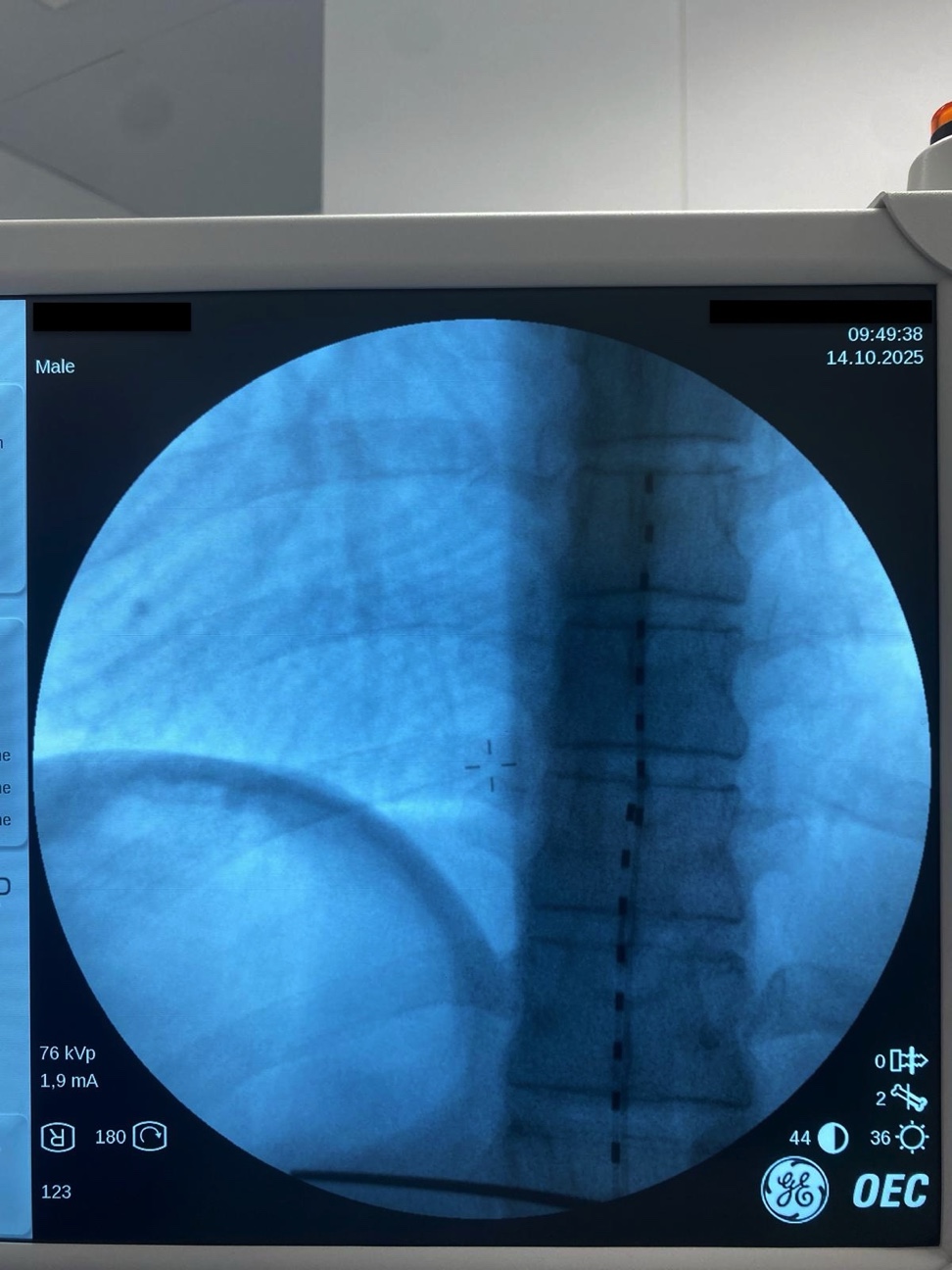
Methods. We report the case of a patient with a spinal cord injury secondary to a spinal puncture. Contrast-enhanced lumbosacral MRI revealed a T2-hyperintense area posterior to the conus medullaris (L1-L2). EMG of the lower limbs showed marked neurogenic compromise with denervation features in the left medial gastrocnemius muscle and severe compromise of the left tibial nerve. Clinically, the patient presented with severe neuropathic pain in the left L4 territory (great toe), perineal hypoesthesia, severe sphincter deficit (frequent/weak urinary stream, fecal incontinence), and sexual dysfunction (absence of erection and ejaculation), all refractory to medications (including cannabis) and pulsed radiofrequency of the L4 dorsal root ganglion. Baseline scores were NRS 10, DN4 8/10, and SF-12: PCS12 23.39, MCS12 17.10. A 10-kHz SCS system was implanted using two octpolar leads (one lead with the first distal electrode at T8 and the other lead with the first distal electrode at T10). Clinical follow-up was performed at 6 months, with a 12-month follow-up planned.
Results. Activation of 10-kHz stimulation resulted in immediate symptomatic relief and restoration of autonomic functions: regular urinary stream, bowel control, and recovery of erection and eiaculation. At the 6-month follow-up, a drastic reduction in pain was documented (NRS 4, DN4 4). SF-12 scores demonstrated a sharp increase in quality of life (PCS12: 37.95; MCS12: 29.23). No complications were recorded. Further clinical improvement was hypothesized by optimizing target mapping through waveform programming adjustments.
Conclusions. This case demonstrates that dual-lead HF-SCS can be a safe and effective therapeutic option for the management of complex neuropathic pain as well as severe sphincter and sexual dysfunctions secondary to iatrogenic conus medullaris injuries.
Downloads
1. Kapural L, Yu C, Doust MW, et al. Novel 10-kHz High-frequency Therapy (HF10 Therapy) Is Superior to Traditional Low-frequency Spinal Cord Stimulation for the Treatment of Chronic Back and Leg Pain: Clinical Trial Results. Anesthesiology. 2015;123(4):851-860. doi:10.1097/ALN.0000000000000774.
2. Deer TR, Mekhail N, Provenzano D, et al. The Appropriate Use of Neurostimulation of the Spinal Cord and Peripheral Nervous System for the Treatment of Chronic Pain and Ischemic Diseases: The Neuromodulation Appropriateness Consensus Committee. Neuromodulation. 2014;17(6):515-550. doi:10.1111/ner.12208.
3. Schieferdecker S, Neudorfer C, El Majdoub F, Maarouf M. A Retrospective Case Series of High-Frequency Spinal Cord Stimulation (HF10-SCS) in Neurogenic Bladder Incontinence. Oper Neurosurg. 2019;17(1):14-20. doi:10.1093/ons/opy223.
How to Cite

This work is licensed under a Creative Commons Attribution-NonCommercial 4.0 International License.
PAGEPress has chosen to apply the Creative Commons Attribution NonCommercial 4.0 International License (CC BY-NC 4.0) to all manuscripts to be published.