
National Conference of the Italian Association for the Study of Pain
Vol. 3 No. s2 (2026): 49th National Conference of the Italian Association for the Study of Pain
 https://doi.org/10.4081/ahr.2026.272
TOWARD A CORE CURRICULUM FOR NURSES ASSISTING ULTRASOUND-GUIDED PAIN PROCEDURES
I. Olivieri, G. Di Giuseppe, C. Angeletti | Anestesia, Rianimazione, Terapia del dolore, Ospedale G. Mazzini, Teramo, Italy
Publisher's note
All claims expressed in this article are solely those of the authors and do not necessarily represent those of their affiliated organizations, or those of the publisher, the editors and the reviewers. Any product that may be evaluated in this article or claim that may be made by its manufacturer is not guaranteed or endorsed by the publisher.
All claims expressed in this article are solely those of the authors and do not necessarily represent those of their affiliated organizations, or those of the publisher, the editors and the reviewers. Any product that may be evaluated in this article or claim that may be made by its manufacturer is not guaranteed or endorsed by the publisher.
Received: 21 September 2026
Published: 21 September 2026
Published: 21 September 2026
0
Views
Methods. A PRISMA-ScR-based methodology was developed to map the literature on nursing roles, competency domains, educational models, and assessment strategies related to ultrasound-guided regional anesthesia, acute pain services, catheter-based analgesia, and bedside pain-related interventions. Registered nurses, advanced practice nurses, and nurse anesthetists will be included, with scope of practice analyzed separately.
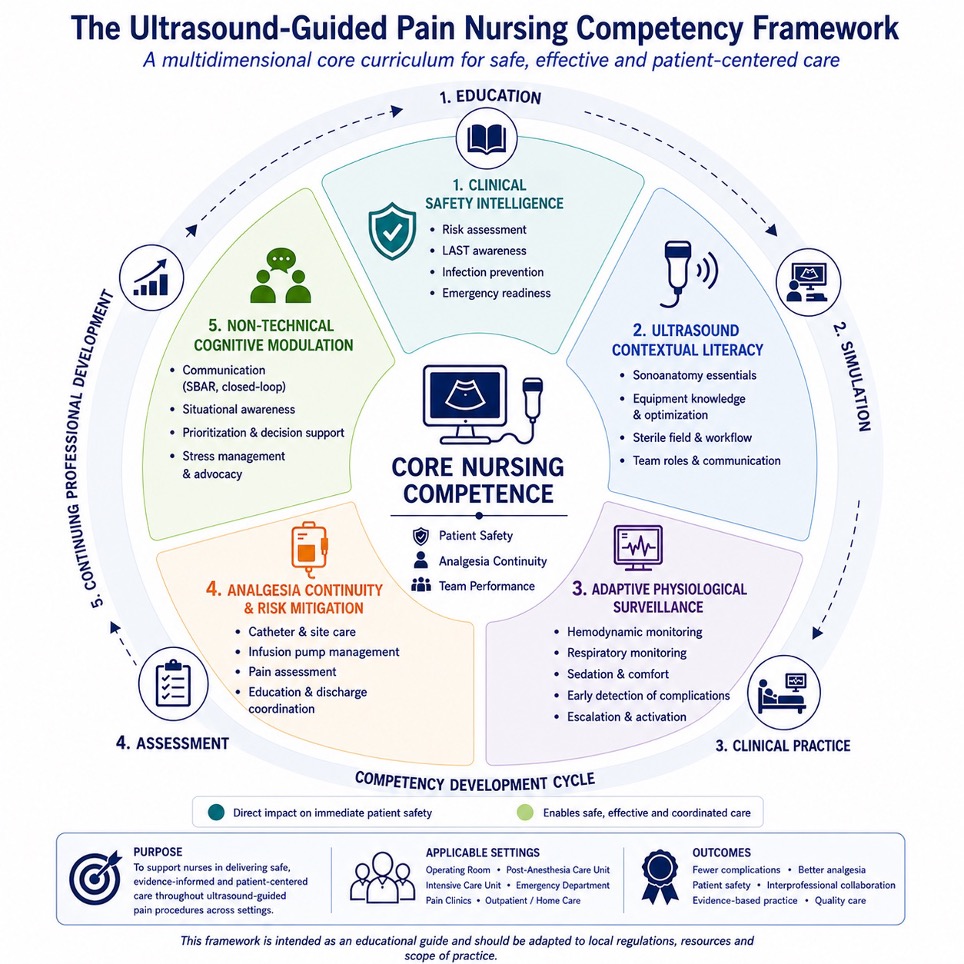
Proposed Framework. Five preliminary competency domains are proposed: clinical safety intelligence; ultrasound contextual literacy; adaptive physiological surveillance; continuity of analgesia and risk mitigation; and non-technical cognitive modulation. These domains may support structured education, simulation-based training, logbook development, and competency assessment.
Conclusion. A dedicated core curriculum may strengthen nursing's contribution to ultrasound-guided pain care by improving role clarity, procedural safety, continuity of analgesia, and interprofessional collaboration. This proposal aims to stimulate collaboration with nursing researchers and scientific societies to develop scoping reviews, conduct Delphi consensus, and validate the curriculum.
Downloads
Download data is not yet available.
- Neal JM, Neal EJ, Weinberg GL. American Society of Regional Anesthesia and Pain Medicine Local Anesthetic Systemic Toxicity checklist: 2020 version. Reg Anesth Pain Med.2021. - Ten Cate O.Competency-Based Education, Entrustable Professional Activities, and the Power of Language. J Grad Med Educ. 2013.
How to Cite
1.
TOWARD A CORE CURRICULUM FOR NURSES ASSISTING ULTRASOUND-GUIDED PAIN PROCEDURES: I. Olivieri, G. Di Giuseppe, C. Angeletti | Anestesia, Rianimazione, Terapia del dolore, Ospedale G. Mazzini, Teramo, Italy. Adv Health Res [Internet]. 2026 Sep. 21 [cited 2026 Sep. 29];3(s2). Available from: https://www.ahr-journal.org/site/article/view/272
Copyright (c) 2026 The Author(s)


This work is licensed under a Creative Commons Attribution-NonCommercial 4.0 International License.
PAGEPress has chosen to apply the Creative Commons Attribution NonCommercial 4.0 International License (CC BY-NC 4.0) to all manuscripts to be published.