
National Conference of the Italian Association for the Study of Pain
Vol. 3 No. s2 (2026): 49th National Conference of the Italian Association for the Study of Pain
 https://doi.org/10.4081/ahr.2026.270
ACUTE PAIN SERVICE IN CATTINARA HOSPITAL IN TRIESTE: APPROACH AND ORGANIZATION
G. Nieddu, M. Grion, R. Dezzoni, E. Roman-Pognuz | Anestesia, rianimazione e terapia antalgica, ospedale universitario di Cattinara ASUGI, Trieste, Italy
Publisher's note
All claims expressed in this article are solely those of the authors and do not necessarily represent those of their affiliated organizations, or those of the publisher, the editors and the reviewers. Any product that may be evaluated in this article or claim that may be made by its manufacturer is not guaranteed or endorsed by the publisher.
All claims expressed in this article are solely those of the authors and do not necessarily represent those of their affiliated organizations, or those of the publisher, the editors and the reviewers. Any product that may be evaluated in this article or claim that may be made by its manufacturer is not guaranteed or endorsed by the publisher.
Received: 21 September 2026
Published: 21 September 2026
Published: 21 September 2026
0
Views
Materials and Methods. The operating room anesthesiologist contacts the APS to refer patients undergoing surgery where PAP is presumed to be of moderate-to-severe intensity and for whom a therapeutic strategy has been planned. Thus, the team is responsible for managing the devices placed for PAP control, such as electronic CADD pumps with a Patient-Controlled Analgesia (PCA) system or elastomeric pumps for intravenous, epidural, or perineural drug infusion. Should PAP remain inadequately controlled, the APS team adjusts dosages and device parameters following institutional protocols, supervised by the anesthesiologist and/or the Service Director. Each patient is assessed six times within the first 24 hours and three times daily on following days. The duration of follow-up is determined by the individual clinical picture, typically ranging from 2 to 4–5 days. A dedicated Postoperative Analgesia Record is completed for each patient, documenting medical history, intraoperative analgesic management, and postoperative analgesia prescription in the first section, and clinical monitoring parameters — including pain intensity, vital signs, adverse events attributable to analgesic use or locoregional anesthetic techniques, and sedation levels — as well as APS-led analgesic management in the second section.
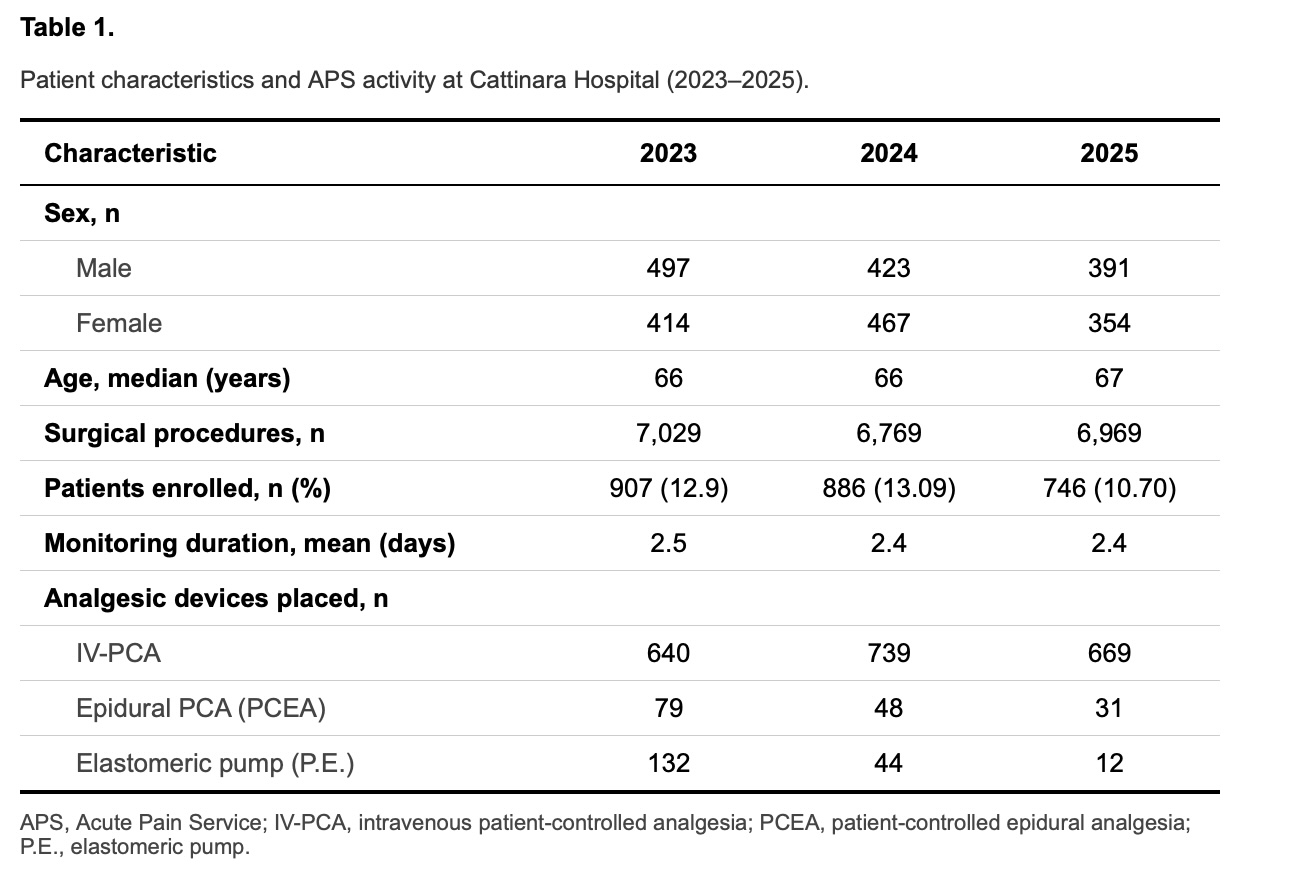
Results. The data summarize APS activity at our institution between 2023 and 2025. In 2023, 907 out of 7029 surgical patients were enrolled (12.9%); 640 intravenous PCA devices, 79 epidural PCA devices, and 132 elastomeric pumps were placed; mean monitoring duration was 2.5 days with a mean of 8.7 assessments per patient. In 2024, 886 out of 6,769 patients were enrolled (13.09%); 739 intravenous PCA devices, 48 epidural PCA devices, and 44 elastomeric pumps were placed; mean monitoring duration was 2.4 days with a mean of 8.9 assessments per patient. In 2025, 746 out of 6969 patients were enrolled (10.70%); 669 intravenous PCA devices, 31 epidural PCA devices, and 12 elastomeric pumps were placed; mean monitoring duration was 2.4 days with a mean of 8.9 assessments per patient. These data constitute a preliminary overview of the service and will serve as the foundation for future studies on postoperative analgesic management.
Downloads
Download data is not yet available.
How to Cite
1.
ACUTE PAIN SERVICE IN CATTINARA HOSPITAL IN TRIESTE: APPROACH AND ORGANIZATION: G. Nieddu, M. Grion, R. Dezzoni, E. Roman-Pognuz | Anestesia, rianimazione e terapia antalgica, ospedale universitario di Cattinara ASUGI, Trieste, Italy. Adv Health Res [Internet]. 2026 Sep. 21 [cited 2026 Sep. 30];3(s2). Available from: https://www.ahr-journal.org/site/article/view/270
Copyright (c) 2026 The Author(s)


This work is licensed under a Creative Commons Attribution-NonCommercial 4.0 International License.
PAGEPress has chosen to apply the Creative Commons Attribution NonCommercial 4.0 International License (CC BY-NC 4.0) to all manuscripts to be published.