
 https://doi.org/10.4081/ahr.2026.263
TRANSLATION, CROSS-CULTURAL ADAPTATION, AND VALIDATION OF THE ITALIAN VERSION OF THE PAIN ANXIETY SYMPTOM SCALE 20 SHORT FORM (PASS20-IT)
S. Marraccini, M. Pernici | Università degli Studi di Siena - Dipartimento di Scienze Mediche, Chirurgiche, Neuroscienze, Italy

All claims expressed in this article are solely those of the authors and do not necessarily represent those of their affiliated organizations, or those of the publisher, the editors and the reviewers. Any product that may be evaluated in this article or claim that may be made by its manufacturer is not guaranteed or endorsed by the publisher.
Published: 21 September 2026
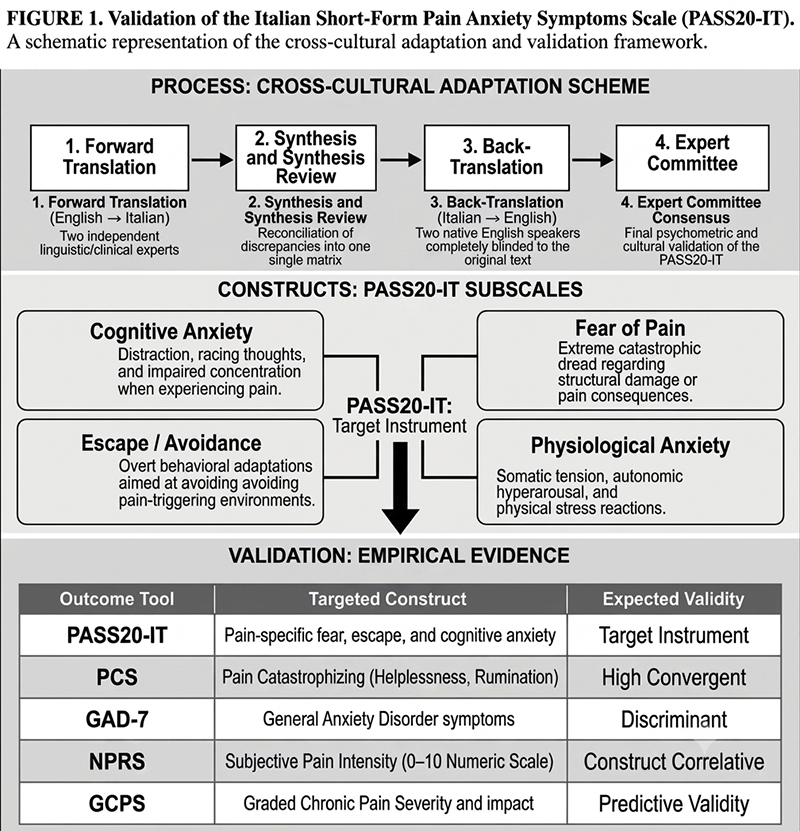
Methods. The Italian translation and cross-cultural adaptation process was based on international guidelines⁽², adhering to six rigorous phases: (a) two forward-translations from English to Italian; (b) synthesis of the forward-translations; (c) back-translations; (d) comparison between the back- translations and the original questionnaire by an expert committee; (e) pre-testing; and (f) final approval of the Italian version of the PASS-20. To validate the instrument, 200 participants with persistent pain were recruited to complete the PASS-20-IT alongside construct validity outcome measures, including the Generalized Anxiety Disorder-7 (GAD-7), the Pain Catastrophizing Scale (PCS), the Numerical Pain Rating Scale (NPRS), and the Graded Chronic Pain Scale (GCPS). The psychometric properties of the questionnaire will be evaluated by determining 8-day test-retest reliability(3), internal consistency(4), construct validity(5), and floor/ceiling effects(6).
Expected Results. Psychometric validation of the PASS-20-IT for the assessment of pain-related anxiety.
Conclusions. The PASS-20-IT project aims to provide the Italian clinical community with the first formal, psychometric-robust validation of the PASS-20. The expected findings will address a significant methodological gap, offering a brief and agile tool essential for the triage and phenotyping of patients suffering from persistent pain. Integrating the PASS-20 into clinical practice will represent a crucial advancement toward a genuine biopsychosocial approach, enabling the identification of non-nociceptive drivers of disability and the monitoring of treatment efficacy in reducing anxiety and avoidance behaviors.
Downloads
1. McCracken LM, Dhingra L. A short version of the Pain Anxiety Symptoms Scale (PASS- 20): preliminary development and validity. Pain Res Manag. 2002;7(1):45-50. doi:10.1155/2002/517163.
2. Beaton DE, Bombardier C, Guillemin F, Ferraz MB, Marcos B. Guidelines for the process of cross-cultural adaptation of self-report measures. Spine (Phila Pa 1976). 2000;25(24):3186–3191. doi: 10.1097/00007632-200012150-00014.
3. Koo TK, Li MY. A Guideline of Selecting and Reporting Intraclass Correlation Coefficients for Reliability Research. J Chiropr Med. 2016;15(2):155-163. doi: 10.1016/j.jcm.2016.02.012.
4. Bland JM, Altman DG. Cronbach's alpha. BMJ. 1997;314(7080):572. doi:10.1136/bmj.314.7080.572.
5. Long JS. Confirmatory Factor Analysis. SAGE Publications Inc; 1983. doi:10.4135/9781412983778.
6. Terwee CB, Bot SD, de Boer MR, van der Windt DA, Knol DL, Dekker J, Bouter LM, de Vet HC. Quality criteria were proposed for measurement properties of health status questionnaires. J Clin Epidemiol. 2007;60(1):34-42. doi: 10.1016/j.jclinepi.2006.03.012
How to Cite

This work is licensed under a Creative Commons Attribution-NonCommercial 4.0 International License.
PAGEPress has chosen to apply the Creative Commons Attribution NonCommercial 4.0 International License (CC BY-NC 4.0) to all manuscripts to be published.