
 https://doi.org/10.4081/ahr.2026.262
CHRONIC PAIN PREVALENCE IN ITALY: GEOGRAPHICAL DISTRIBUTION, COMORBIDITIES AND PSYCHOSOCIAL BURDEN FROM THE MULTIPURPOSE NATIONAL SURVEYS “ASPETTI DELLA VITA QUOTIDIANA” 2022-2023
A. Maraschini1, M. Tenti2, W. Raffaeli2, G. Minelli1, E. Bologna3, L. Gargiulo3, L. Iannucci3, A. Burgio3, I. Cascavilla1, A. Maione1, M. Ferri1, V. Toccaceli1 | 1Istituto Superiore di Sanità, Roma, Italy; 2Fondazione ISAL, Rimini, Italy; 3ISTAT, Roma, Italy
All claims expressed in this article are solely those of the authors and do not necessarily represent those of their affiliated organizations, or those of the publisher, the editors and the reviewers. Any product that may be evaluated in this article or claim that may be made by its manufacturer is not guaranteed or endorsed by the publisher.
Published: 21 September 2026
Methods. Data from the 2022-2023 National Multipurpose ISTAT surveys “Aspetti della vita quotidiana”, including a validated 5-item Chronic Pain Questionnaire (7), were analyzed. The samples (2022: n=35,954; 2023: n=35,695) were representative of the Italian population aged ≥18 years. Descriptive analyses evaluated CP prevalence, standardized geographical differences, and comorbidities. Multivariate logistic regression models assessed the dose-response gradient between CP intensity and (i) obesity, (ii) physical inactivity, (iii) psychosocial well-being, (iv) self-reported health, and (v) activity limitations, adjusting for socio-demographic characteristics.
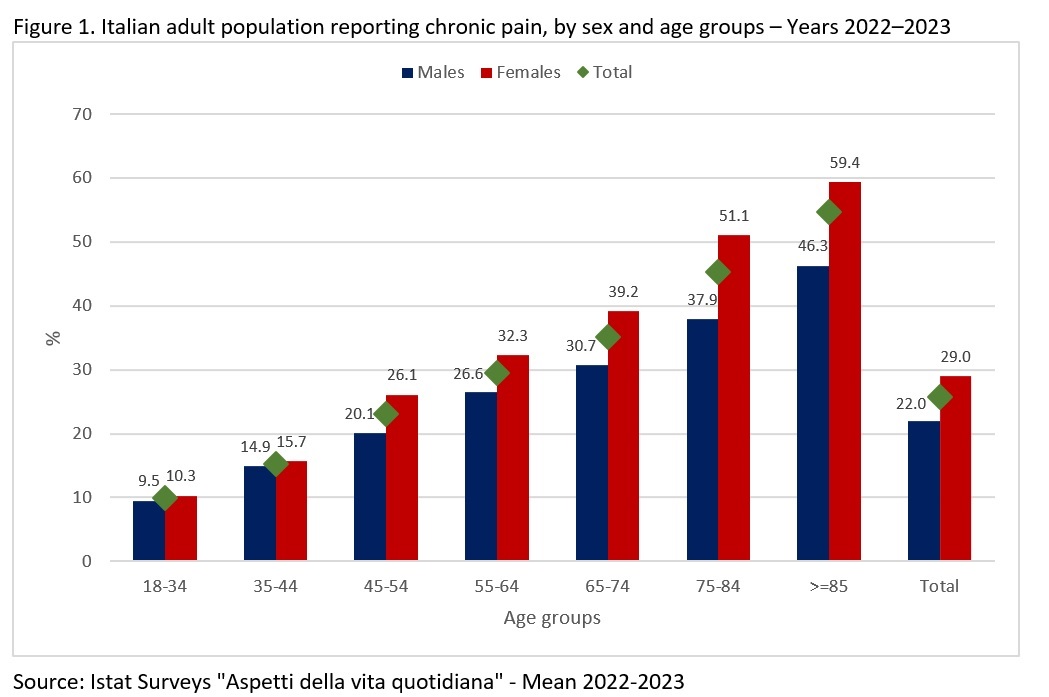
Results. The surveys estimated that nearly 13 million adults in Italy suffer from CP, representing 25.7% of the adult population (22.0% in males, 29.0% in females). Regarding intensity, among sufferers, 19.5% reported mild, 57.6% moderate, and 22.9% severe pain. Age-standardized prevalence was higher in Northern Italy (24.5%) than in the Center (22.8%) and South (22.7%), reversing after age 65. Among sufferers, 18.0% attributed pain to an undiagnosed condition, 19.0% received no therapy, and 16.1% under treatment reported it as entirely ineffective. Osteoarthritis/arthrosis (43.7%) was the most prevalent comorbidity. Depressive symptoms affected 11.4% of CP sufferers vs 2.8% of CP-free subjects. Significant dose-response associations emerged between CP intensity and obesity (OR: 1.25 mild, 1.28 moderate, 1.52 severe). Physical inactivity showed an inverse association with mild pain (OR: 0.84; 95%CI: 0.78–0.91) but a strong positive association with severe pain (OR: 1.64; 95%CI: 1.52–1.76). Psychosocial well-being was severely compromised: life dissatisfaction (OR: 1.21, 1.56, 2.83) and psychological distress (OR: 1.47, 2.14, 5.03) escalated with pain intensity. Finally, severe pain was robustly associated with major activity limitations (OR: 9.53; 95%CI: 8.65–10.49).
Conclusion. CP affects approximately one-quarter of the Italian adult population, confirming its substantial public health burden. Compared with 2019 estimates, overall prevalence appeared slightly increased, particularly in Northern and Central Italy. Beyond prevalence, care access and management indicators appeared to worsen: undiagnosed CP-related conditions increased (18.0% vs 13.6% in 2019), as did those receiving no treatment (19.0% vs 14.8%) and perceiving treatments as ineffective (16.1% vs 7.6%). These findings highlight growing unmet healthcare needs, reinforcing the need for strengthened diagnostic pathways, improved treatment effectiveness, and integrated care strategies. Continuous monitoring remains essential to inform public health strategies.
Downloads
1. Treede R.-D., Rief W., Barke A., Aziz Q., Bennett M.I., Benoliel R., Cohen M., Evers S., Finnerup N.B., First M.B., et al. A classification of chronic pain for ICD-11. Pain. 2015;156:1003–1007. doi: 10.1097/j.pain.0000000000000160.
2. Niv D., Devor M. Chronic pain as a disease in its own right. Pain Pract. 2004;4:179–181. doi: 10.1111/j.1533-2500.2004.04301.x.
3. Vos T., Flaxman A.D., Naghavi M., Lozano R., Michaud C., Ezzati M., Shibuya K., Salomon J.A., Abdalla S., Aboyans V., et al. Years Lived with Disability (YLDs) for 1160 Sequelae of 289 Diseases and Injuries 1990–2010: A Systematic Analysis for the Global Burden of Disease Study 2010. Lancet. 2012;380:2163–2196. doi: 10.1016/S0140-6736(12)61729-2.
4. Dueñas M., Ojeda B., Salazar A., Mico J.A., Failde I. A Review of Chronic Pain Impact on Patients, Their Social Environment and the Health Care System. J. Pain Res. 2016;9:457–467. doi: 10.2147/JPR.S105892.
5. Toccaceli V, Francia N, Cascavilla I, Tenti M, eds. Dolore cronico in Italia e suoi correlati psicosociali dalla “Indagine europea sulla salute” (European Health Interview Survey) 2019. Istituto Superiore di Sanità; 2023. Rapporti ISTISAN 23/28.
6. Maraschini A, Tenti M, Raffaeli W, et al. Chronic pain prevalence and psychosocial burden in the Italian population from the 2019 European Health Interview Survey. Int J Environ Res Public Health. 2025;22(9):1395. doi:10.3390/ijerph22091395.
7. Toccaceli V, Tenti M, Stazi MA, Fagnani C, Medda E, Gargiulo L, Burgio A, Sampaolo L, Ferri M, Raffaeli W. Development and Validation of the Italian "Brief Five-Item Chronic Pain Questionnaire" for Epidemiological Studies. J Pain Res. 2022 Jul 8;15:1897-1913. doi: 10.2147/JPR.S362510. PMID: 35837542; PMCID: PMC9275508.
How to Cite

This work is licensed under a Creative Commons Attribution-NonCommercial 4.0 International License.
PAGEPress has chosen to apply the Creative Commons Attribution NonCommercial 4.0 International License (CC BY-NC 4.0) to all manuscripts to be published.