
 https://doi.org/10.4081/ahr.2026.255
PERIOPERATIVE ALIAMIDES (PEA Q AND ADELMIDROL) ENHANCE MELOXICAM ANALGESIA IN CATS UNDERGOING TOOTH EXTRACTION: A RANDOMIZED DOUBLE BLIND PLACEBO CONTROLLED TRIAL
D. Gamba1, F. Colonna1, K. Weizman1, C. Schievano2, G. Vidili3, M.F. Della Valle3, G. Della Rocca4 | 1Clinica Veterinaria Gran Sasso, Milano, Italia; 2Innovative Statistical Research Srl, Padova, Italy; 3Innovet Italia Srl, Saccolongo (PD), Italy; 4Dipartimento di Medicina Veterinaria, Centro di Ricerca Sul Dolore Animale (CeRiDA), Università degli Studi di Perugia, Italy
All claims expressed in this article are solely those of the authors and do not necessarily represent those of their affiliated organizations, or those of the publisher, the editors and the reviewers. Any product that may be evaluated in this article or claim that may be made by its manufacturer is not guaranteed or endorsed by the publisher.
Published: 21 September 2026
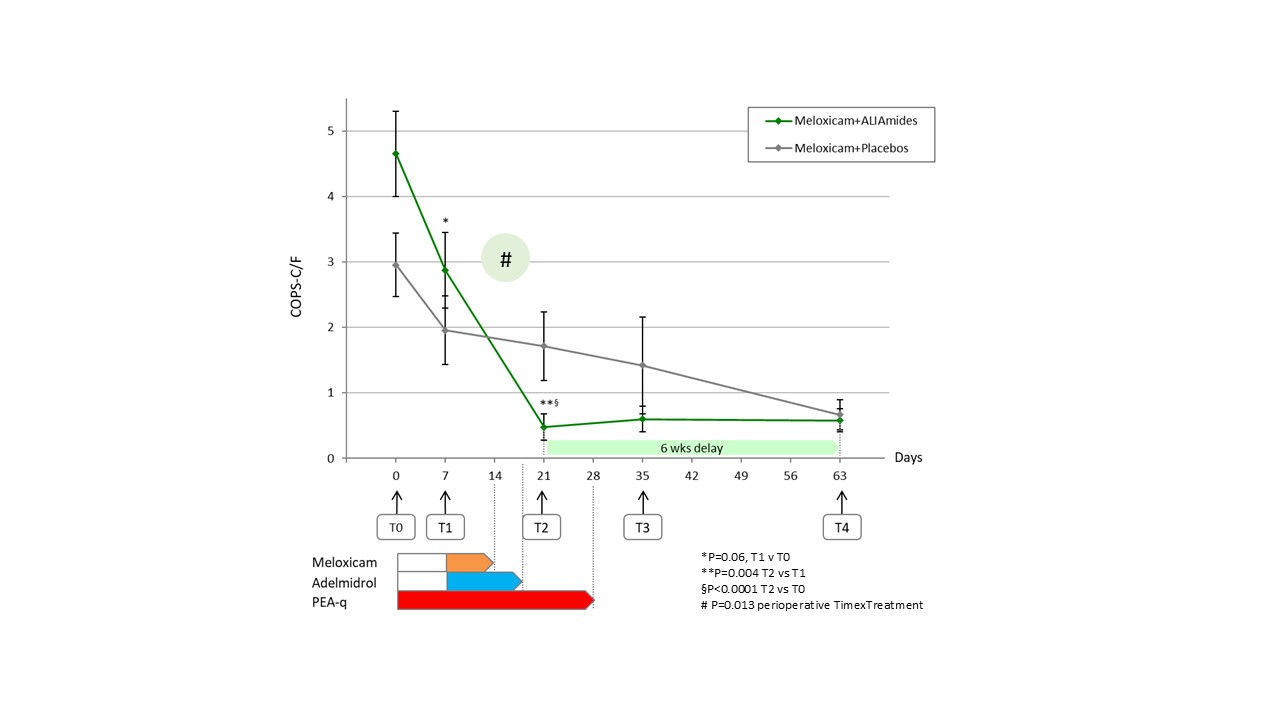
Methods. Client-owned indoor cats (≥1 year) undergoing dental extraction for feline odontoclastic resorptive lesions, periodontitis, or retained roots were randomized to treatment (T) or control (C). Exclusion criteria included pregnancy/lactation, comorbidities, and recent use of steroids, analgesics, immunosuppressants, or NSAIDs. All cats received meloxicam post-operatively (0.1 mg/kg day 1; 0.05 mg/kg for 6 days). T cats additionally received oral PEA co-ultramicronized with quercetin (PEA-q, 1 week pre- to 3 weeks post-surgery) and 2% adelmidrol gingival gel (10 days post-surgery), while C cats received placebos. PEA-q (100 mg/mL) was administered twice daily (0.5-1.5 mL by body weight). Oral pain was assessed using the owner-completed COPS-C/F questionnaire (2) at inclusion (T0), within 24 h before dental extraction (T1), 2 weeks post-operatively (T2), and during two follow-up phone calls at 1 month (T3) and 2 months (T4) after surgery. At T2 (owner and veterinary pain specialist) and T3 (owner only), satisfaction with pain management was assessed by a 0 (not satisfied) to 4 (very satisfied) global score. Adverse events were recorded whenever they occurred, including suspected causality. Data were analyzed using GLMM (age, sex as covariates) with Tukey–Kramer post hoc tests (P<0.05).
Results. Forty-five cats were enrolled, treated surgically, and randomized (23 to T and 22 to C). Twelve were females and 33 males (all neutered except one per sex), mean age 6 years 10 months (range 1–17) and mean body weight 4.9 ± 1.1 kg. Despite randomization, baseline pain scores were higher in T compared to C (P=0.012). Pain reduction from T0 to T2 differed between groups (P=0.013), with a marked decrease in T (−90%), which approached significance pre-operatively (T0-T1, P=0.060) and was significant in the following 2 weeks (T1-T2, P=0.004), reaching near-zero values and remaining stable thereafter (Figure). In contrast, C cats showed a non-significant pain reduction, achieving similar scores only at the final follow-up (T4), with a 6-week delay compared with T (Figure). Pain control satisfaction was high overall, slightly favoring T, based on both owner and veterinary pain specialist assessments. No adverse events occurred up to T2; during follow-up, vomiting was reported in one T (unrelated) and one C cat, without study withdrawal.
Conclusion. Adjunctive perioperative ALIAmides were well tolerated, significantly enhanced meloxicam analgesia, and enabled faster pain relief, supporting multimodal pain management in cats with dental diseases.
Downloads
1. Nobili S, Micheli L, Lucarini E, Toti A, Ghelardini C, Mannelli LDC. Ultramicronized N-palmitoylethanolamine associated with analgesics. Pharmacol Ther. 2024;258:108649.
2. Della Rocca G, Di Salvo A, Marenzoni ML, Bellezza E, Pastorino G, Monteiro B, Steagall P. Development, preliminary validation, and refinement of the Composite Oral and Maxillofacial Pain Scale-Canine/Feline (COPS-C/F). Front Vet Sci. 2019;6:274.
How to Cite

This work is licensed under a Creative Commons Attribution-NonCommercial 4.0 International License.
PAGEPress has chosen to apply the Creative Commons Attribution NonCommercial 4.0 International License (CC BY-NC 4.0) to all manuscripts to be published.