
 https://doi.org/10.4081/ahr.2026.254
RECURRENT PREPATELLAR BURSITIS IN A SEVERELY OBESE CORTICOSTEROID-INTOLERANT OCTOGENARIAN: SERIAL ULTRASOUND IMPROVEMENT AFTER OXYGEN–OZONE THERAPY
G. Galasso, G. Lambiase, M.M. Fabris, D. Scarano, C. Amendola, D. Carbone | UOC Anestesia e Rianiazione DEA Nocera-Pagani-Scafati, Nocera Inferiore (SA), Italy
All claims expressed in this article are solely those of the authors and do not necessarily represent those of their affiliated organizations, or those of the publisher, the editors and the reviewers. Any product that may be evaluated in this article or claim that may be made by its manufacturer is not guaranteed or endorsed by the publisher.
Published: 21 September 2026
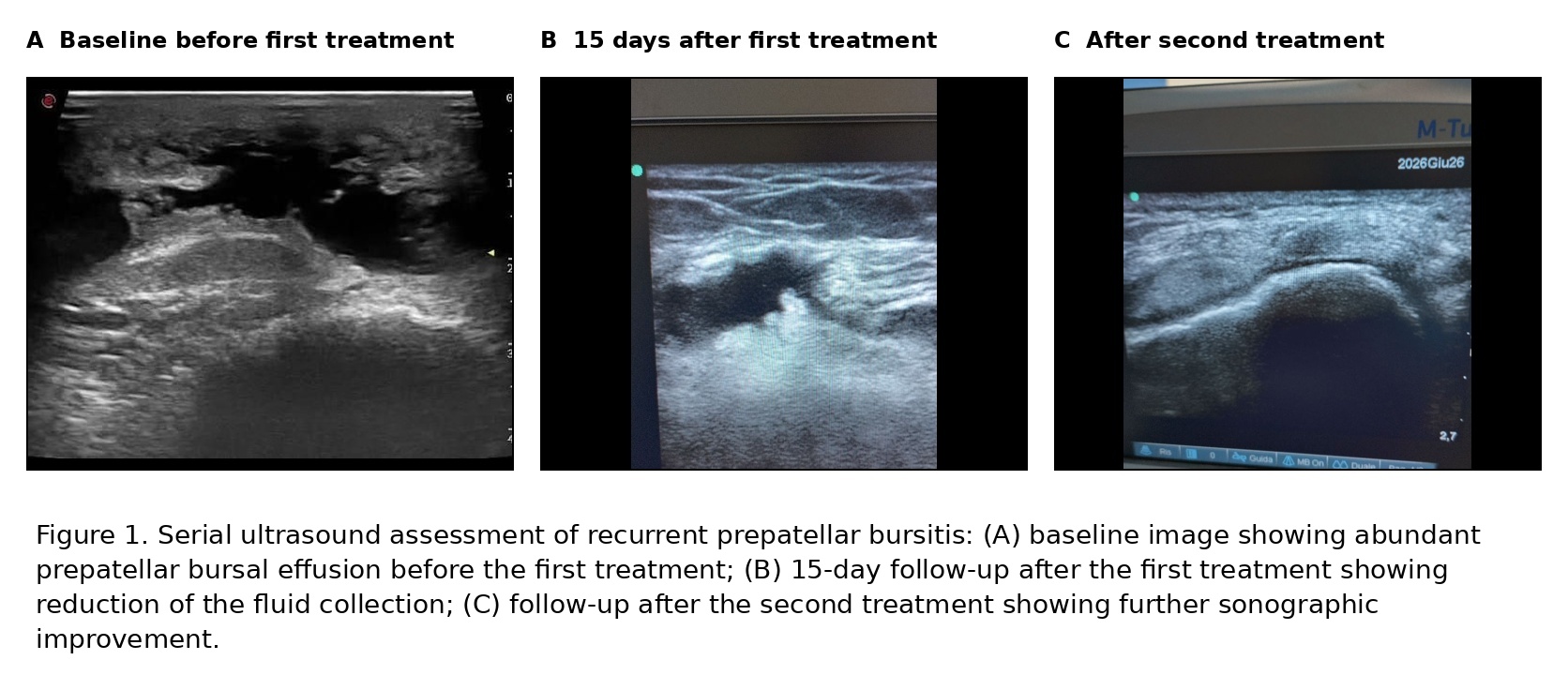
Methods. An 80-year-old severely obese woman (BMI >41) presented with recurrent prepatellar bursitis with abundant effusion documented on baseline ultrasound. Her medical history included chronic obstructive pulmonary disease and nocturnal CPAP for obstructive sleep apnea. Because of corticosteroid intolerance, she underwent infiltrative treatment with oxygen–ozone at a concentration of 7 μg/mL, total volume 10 mL, associated with peri-bursal Arnica Heel Arnica Complex. Clinical and ultrasound reassessment was performed 15 days after the first treatment. A second treatment session was then carried out, followed by a further clinical and ultrasound follow-up after 15 days.
Results. At first follow-up, local swelling had decreased, gait had improved, and ultrasound showed a reduction in bursal fluid collection. After the second treatment, further improvement was observed both clinically and sonographically, with better ambulation and additional reduction of the effusion.
Conclusions. In this case, oxygen–ozone therapy associated with peri-bursal Arnica Heel Complex was followed by progressive short-term clinical and ultrasound improvement in recurrent prepatellar bursitis in a frail elderly patient with severe obesity and corticosteroid intolerance. This minimally invasive approach may be considered in selected cases when steroid infiltration is poorly tolerated or not feasible. Further observations are needed to define its role more clearly.
Downloads
1. Rishor-Olney CR, Taqi M, Pozun A. Prepatellar Bursitis. In: StatPearls [Internet]. Treasure Island (FL): StatPearls Publishing; updated January 4, 2024. NCBI Bookshelf.
2. Akkawi I. Ozone therapy for musculoskeletal disorders: Current concepts. Acta Biomed. 2020;91(4):e2020191. doi:10.23750/abm.v91i4.8979.
3. Zhuang ZG, Lu LJ, Peng BG, et al. China Expert Consensus on the Application of Ozone Therapy in the Pain Department. Pain Res Manag. 2021;2021:6654269. doi:10.1155/2021/6654269. Article
How to Cite

This work is licensed under a Creative Commons Attribution-NonCommercial 4.0 International License.
PAGEPress has chosen to apply the Creative Commons Attribution NonCommercial 4.0 International License (CC BY-NC 4.0) to all manuscripts to be published.