
National Conference of the Italian Association for the Study of Pain
Vol. 3 No. s2 (2026): 49th National Conference of the Italian Association for the Study of Pain
 https://doi.org/10.4081/ahr.2026.240
PREGNANCY-RELATED PELVIC GIRDLE PAIN: DIAGNOSTIC CHALLENGES AND CONSERVATIVE MANAGEMENT OPTIONS
G. Di Giuseppe1, I. Olivieri1, C. Angeletti2 | 1Dip.to Anestesia, Terapia intensiva e Terapia del dolore, Ospedale Mazzini, Teramo, Italy; 2L'Aquila, Italy

Publisher's note
All claims expressed in this article are solely those of the authors and do not necessarily represent those of their affiliated organizations, or those of the publisher, the editors and the reviewers. Any product that may be evaluated in this article or claim that may be made by its manufacturer is not guaranteed or endorsed by the publisher.
All claims expressed in this article are solely those of the authors and do not necessarily represent those of their affiliated organizations, or those of the publisher, the editors and the reviewers. Any product that may be evaluated in this article or claim that may be made by its manufacturer is not guaranteed or endorsed by the publisher.
Received: 21 September 2026
Published: 21 September 2026
Published: 21 September 2026
0
Views
Methods. This work was developed as a narrative clinical overview based on selected relevant literature covering epidemiology, proposed mechanisms, risk factors, clinical presentation, diagnostic assessment, and treatment options for PRPGP. Attention was given to distinguishing PRPGP from LBP and to conservative, pharmacological, and complementary approaches applicable during pregnancy.
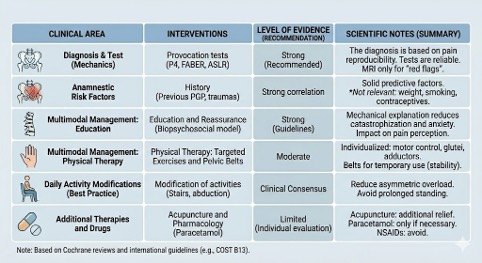
Results. Reported prevalence estimates vary widely, reflecting heterogeneous definitions, diagnostic criteria, and study designs. PRPGP usually develops during pregnancy and may persist into the postpartum period. Its pathophysiology remains incompletely understood and is likely multifactorial, involving biomechanical load redistribution, altered pelvic stability, hormonal influences, and individual vulnerability factors. Previous PGP and LBP are among the most consistently reported risk factors. Diagnosis is primarily clinical and relies on the location of pain, functional limitations and specific provocation tests. Clinical overlap with LBP may contribute to under-recognition or delayed diagnosis. Imaging is not routinely required but may be considered in severe, atypical, or persistent cases, particularly when pubic symphysis diastasis or alternative diagnoses are suspected. Management is primarily conservative and should be individualized. Education, activity modification, pelvic support belts, physiotherapy, and targeted exercise-based interventions may reduce pain and disability. Pharmacological treatment should be carefully tailored to gestational age, maternal comorbidities, pain severity, and fetal safety, with paracetamol generally considered the first-line analgesic. Invasive or surgical approaches have a limited role and should be reserved for selected non-PRPGP differential diagnoses or exceptionally severe cases.
Conclusions. PRPGP is a common yet often underestimated pain condition during pregnancy. A multidisciplinary, individualized approach is needed to improve recognition, reduce disability, and support maternal functioning. Current management remains limited by heterogeneity in diagnostic criteria and treatment protocols, as well as by the generally low quality of evidence supporting many interventions. Further well-designed studies are needed to clarify diagnostic pathways and define effective, safe, and pregnancy-specific treatment strategies. Greater clinical awareness may help avoid normalization of pain, delayed diagnosis, and unnecessary functional limitation during pregnancy.
Downloads
Download data is not yet available.
1. Vleeming A, Albert HB, Ostgaard HC, Sturesson B, Stuge B. European guidelines for the diagnosis and treatment of pelvic girdle pain. Eur Spine J. 2008;17(6):794-819. doi:10.1007/s00586-008-0602-4.
2. Sward L, Manning N, Murchison AB, Ghahremani T, McCaulley JA, Magann EF. Pelvic Girdle Pain in Pregnancy: A Review. Obstet Gynecol Surv. 2023;78(6):349-357. doi:10.1097/OGX.0000000000001140.
How to Cite
1.
PREGNANCY-RELATED PELVIC GIRDLE PAIN: DIAGNOSTIC CHALLENGES AND CONSERVATIVE MANAGEMENT OPTIONS: G. Di Giuseppe1, I. Olivieri1, C. Angeletti2 | 1Dip.to Anestesia, Terapia intensiva e Terapia del dolore, Ospedale Mazzini, Teramo, Italy; 2L’Aquila, Italy. Adv Health Res [Internet]. 2026 Sep. 21 [cited 2026 Sep. 29];3(s2). Available from: https://www.ahr-journal.org/site/article/view/240
Copyright (c) 2026 The Author(s)


This work is licensed under a Creative Commons Attribution-NonCommercial 4.0 International License.
PAGEPress has chosen to apply the Creative Commons Attribution NonCommercial 4.0 International License (CC BY-NC 4.0) to all manuscripts to be published.