
 https://doi.org/10.4081/ahr.2026.238
THE USE OF OXYGEN-OZONE THERAPY, BY BAGGING, AS ADJUVANT TREATMENT, ON THE HEALING OF AN EXTENSIVE SURGICAL WOUND AFTER A TOTAL KNEE REPLACEMENT: A CASE REPORT
S. Di Cianni1, C. Bernacca2, N. Franco1, C. Spadaccini1, M. Rossi1 | 1Department of Anaesthesiology and Reanimation, Section of Pain Management, Presidio Ospedaliero del Levante Ligure, La Spezia, Italy; 2MD in Training Program in Anaesthesiology at University of Pisa, Section of Pain Management, Presidio Ospedaliero del Levante Ligure, La Spezia, Italy
All claims expressed in this article are solely those of the authors and do not necessarily represent those of their affiliated organizations, or those of the publisher, the editors and the reviewers. Any product that may be evaluated in this article or claim that may be made by its manufacturer is not guaranteed or endorsed by the publisher.
Published: 21 September 2026
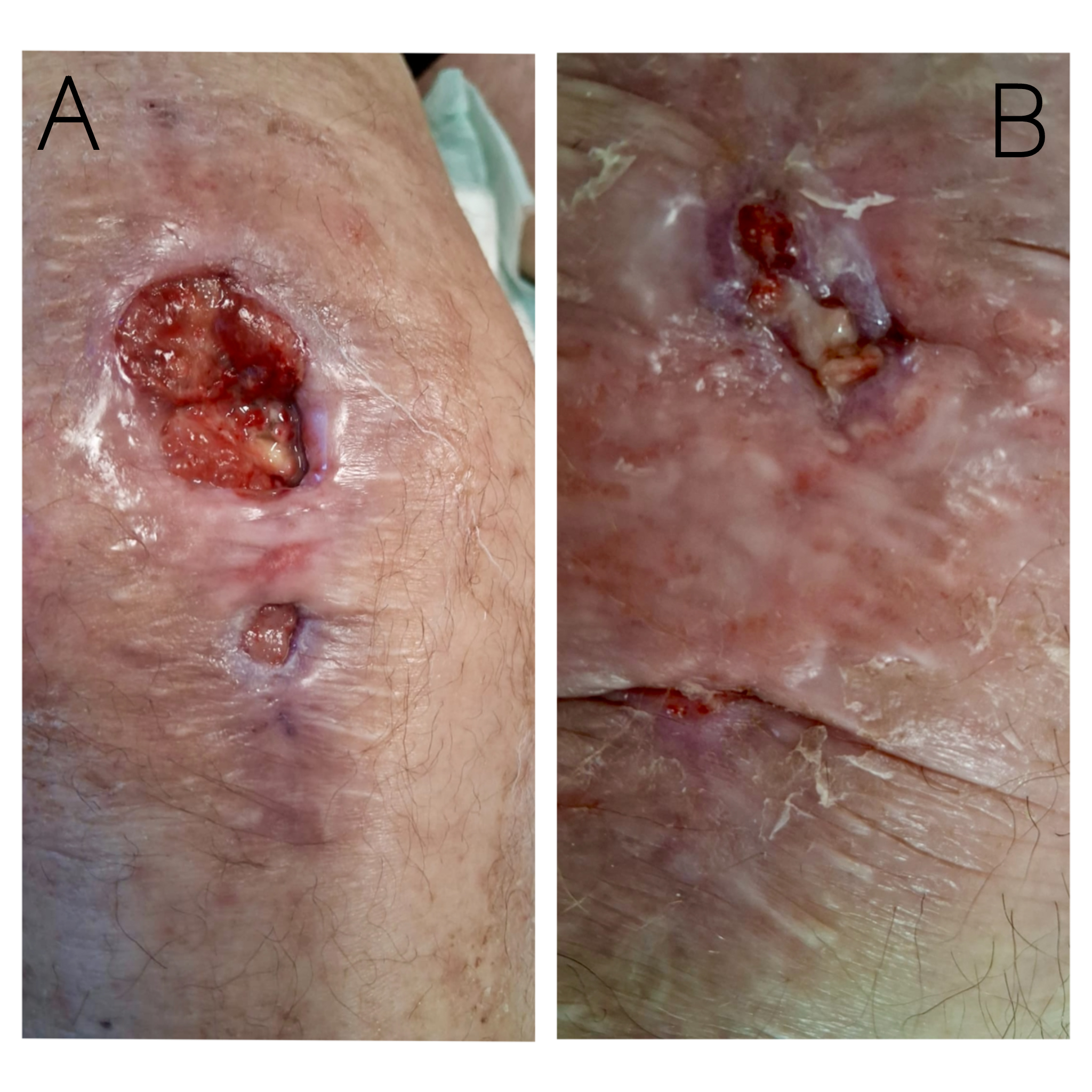
Methods. We present a case of a 66-year-old male with a surgical dehiscence following a robotic total knee replacement surgery, complicated by patella tendon rupture that underwent surgical repair twice. Due to the repeated surgeries and the severe state of inflammation the wound was not healing, and the patient was subjected to wound cleaning and debridement to avoid infections, followed by Vacuum Assisted Closure therapy with poor results on the wound status. A protocol of oxygen-ozone bagging was started, which consisted in placing a bag around the wound filled with ozone mixture of 30 mg/ml dose for 30 minutes, along with daily wound cleaning and sterile dressing. The ozone bagging was applied once a week, for a total of 7 sittings, until complete wound closure was obtained, with no further complications. Figure A (before treatment) and Figure B (end of treatment).
Results. At 2 months follow up, the patient was walking with knee brace and crutches, continuing the rehabilitation program and returning to an independent life, with a significant pain reduction, no sensory and motility deficits.
Conclusion. This case supports the fact that oxygen-ozone bagging can be an appropriate adjuvant approach in the comprehensive treatment of chronic wounds, especially with regards to extensive orthopaedic wounds.(3) (4)
Downloads
1. DJR, et al. Liquid ozone therapies for the treatment of epithelial wounds: A systematic review and meta-analysis. International Wound Journal. 2022, Vol. 20.
2. MI, et al. Health-related wuality of life in patients with chronic wounds before and after treatment with medical ozone. Medicine. 48, 2018, Vol. 30, 97.
3. EF, OJH, JJV. Ozone therapy for the treatment of chronic wounds: A systematic review. International Wound Journal. 2018, Vol. 15, 4.
4. HSK, et al. Therapeutic effects of topical application of ozone on acute cutaneous wound healing. Journal of Korean Medical Science. 2009, Vol. 24, 3.
How to Cite

This work is licensed under a Creative Commons Attribution-NonCommercial 4.0 International License.
PAGEPress has chosen to apply the Creative Commons Attribution NonCommercial 4.0 International License (CC BY-NC 4.0) to all manuscripts to be published.