
National Conference of the Italian Association for the Study of Pain
Vol. 3 No. s2 (2026): 49th National Conference of the Italian Association for the Study of Pain
 https://doi.org/10.4081/ahr.2026.234
EMOTIONAL ALLODYNIA IN FIBROMYALGIA: PSYCHOMETRIC PROPERTIES OF THE AEQ AND CLINICAL CORRELATES – INTERIM ANALYSIS OF THE PEARL STUDY
A. Corriero1, M. Giglio1, A. Pilolla1, S. Ambrosi1, T. Petracca1, T. Campanella1, S. Mavaddati1, F. Fornarelli1, F. Galdini1, C. Di Venosa1, P. Trerotoli2, F. Puntillo1 | 1Department of Interdisciplinary Medicine - Pain and ICU Section, University of Bari Aldo Moro, Italy; 2Department of Interdisciplinary Medicine - Statistics Section, University of Bari Aldo Moro, Bari, Italy
Publisher's note
All claims expressed in this article are solely those of the authors and do not necessarily represent those of their affiliated organizations, or those of the publisher, the editors and the reviewers. Any product that may be evaluated in this article or claim that may be made by its manufacturer is not guaranteed or endorsed by the publisher.
All claims expressed in this article are solely those of the authors and do not necessarily represent those of their affiliated organizations, or those of the publisher, the editors and the reviewers. Any product that may be evaluated in this article or claim that may be made by its manufacturer is not guaranteed or endorsed by the publisher.
Received: 21 September 2026
Published: 21 September 2026
Published: 21 September 2026
1
Views
Methods. STUDIO PEARL is an ongoing prospective observational study at a tertiary pain clinic (Policlinico Hospital, Bari, Italy; Ethics: 2451/CEL). Fibromyalgia patients are consecutively enrolled according to ACR 2016 criteria (3). We report an interim analysis on the first 128 participants (117 F, 11 M; age: 57.5±11.5 years). The assessment battery includes AEQ, PCS, CSI, BDI-II, DERS, STAI-Y1/Y2, and VAS. Psychometric analyses cover internal consistency (Cronbach’s α), factorial structure (EFA, CFA), convergent validity (Spearman’s ρ), and clinical phenotyping via AEQ×CSI median-split stratification.
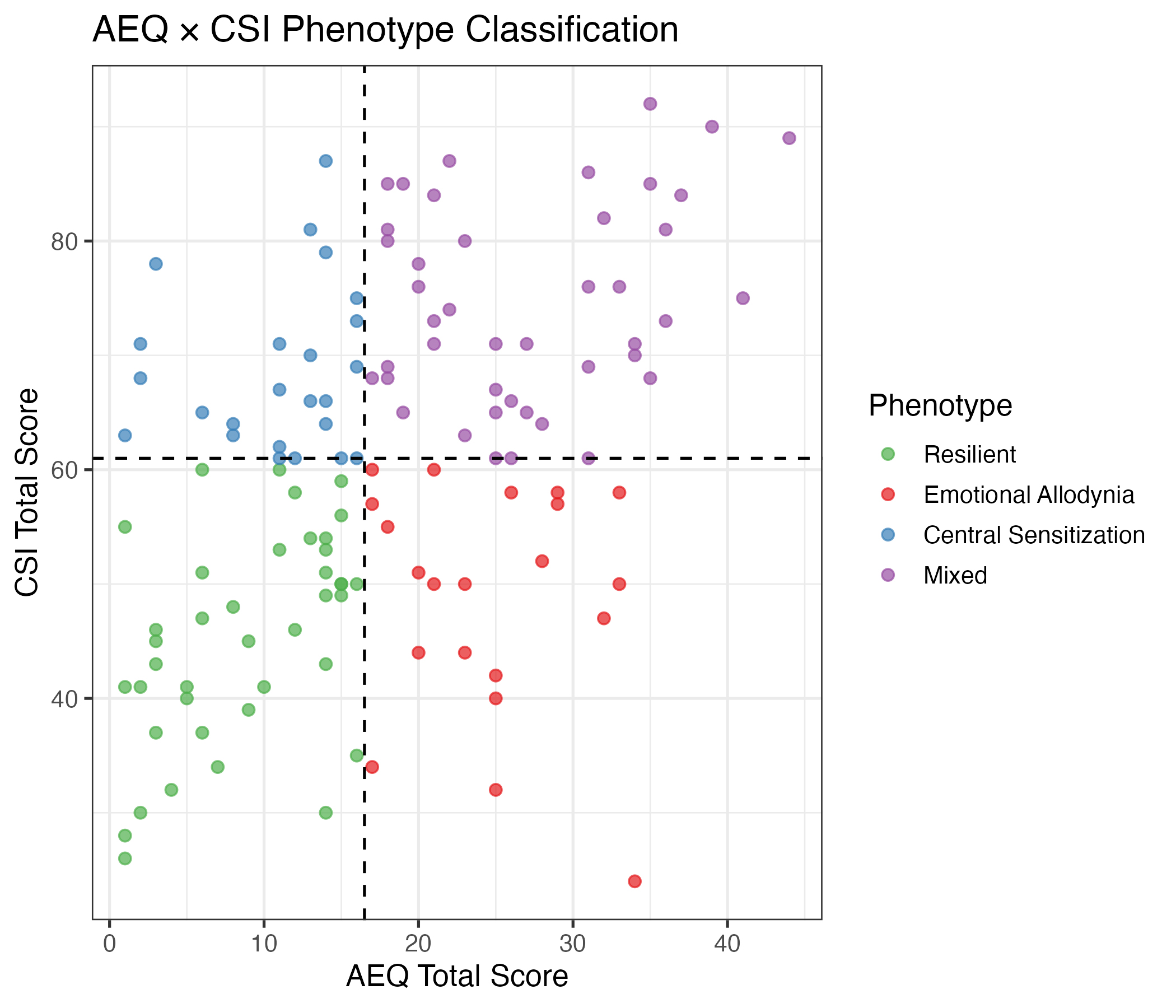
Results. In the current sample, AEQ showed excellent internal consistency (α=0.917). EFA supported a unidimensional structure (KMO=0.90; Bartlett p<.001; loadings: 0.60–0.83; variance explained: 48.8%). The modified CFA model (EQ10–EQ11 residual covariance freed on theoretical grounds) yielded: CFI=0.929, TLI=0.909, RMSEA=0.095, SRMR=0.049. Mean AEQ total score was 17.9±10.4. Convergent validity was supported by Spearman correlations with DERS (ρ=0.617), PCS (ρ=0.603), STAI-Y2 (ρ=0.572), STAI-Y1 (ρ=0.523), BDI-II (ρ=0.517), and CSI (ρ=0.448; all p<.001). Exploratory post hoc AEQ×CSI median-split cross-tabulation suggested four preliminary clinical profiles (resilient, emotional allodynia, central sensitization, mixed) (Figure 1), which differed significantly across all psychometric measures (Kruskal–Wallis p<.001).
Conclusions. This interim analysis on 128 fibromyalgia patients suggests the AEQ has solid psychometric properties: α=0.917, acceptable factorial fit, and convergent correlations up to ρ=0.617 with DERS. The instrument appears to detect a relational-affective dimension that PCS, CSI, DERS, and STAI do not directly target. Enrollment is ongoing; test-retest reliability data are being collected and full validation results will be presented at study completion.
Downloads
Download data is not yet available.
1. Raja SN, Carr DB, Cohen M, et al. The IASP definition of pain. Pain. 2020;161(9):1976‑1982.
2. Kosek E, Cohen M, Baron R, et al. Mechanistic descriptors for chronic pain. Pain. 2016;157(7):1382‑1386.
3. Wolfe F, Clauw DJ, Fitzcharles MA, et al. 2016 fibromyalgia diagnostic criteria. Semin Arthritis Rheum. 2016;46(3):319‑329.
How to Cite
1.
EMOTIONAL ALLODYNIA IN FIBROMYALGIA: PSYCHOMETRIC PROPERTIES OF THE AEQ AND CLINICAL CORRELATES – INTERIM ANALYSIS OF THE PEARL STUDY: A. Corriero1, M. Giglio1, A. Pilolla1, S. Ambrosi1, T. Petracca1, T. Campanella1, S. Mavaddati1, F. Fornarelli1, F. Galdini1, C. Di Venosa1, P. Trerotoli2, F. Puntillo1 | 1Department of Interdisciplinary Medicine - Pain and ICU Section, University of Bari Aldo Moro, Italy; 2Department of Interdisciplinary Medicine - Statistics Section, University of Bari Aldo Moro, Bari, Italy. Adv Health Res [Internet]. 2026 Sep. 21 [cited 2026 Sep. 30];3(s2). Available from: https://www.ahr-journal.org/site/article/view/234
Copyright (c) 2026 The Author(s)


This work is licensed under a Creative Commons Attribution-NonCommercial 4.0 International License.
PAGEPress has chosen to apply the Creative Commons Attribution NonCommercial 4.0 International License (CC BY-NC 4.0) to all manuscripts to be published.