
National Conference of the Italian Association for the Study of Pain
Vol. 3 No. s2 (2026): 49th National Conference of the Italian Association for the Study of Pain
 https://doi.org/10.4081/ahr.2026.232
DRAWING AS A DEVELOPMENTAL AND TRANSCULTURAL CLINICAL TOOL IN THE DIAGNOSIS OF PEDIATRIC HEADACHES
F. Cernigliaro1, E. Correnti2, D. Lopes3, R. Nardello4, A. Messina5, G. Santangelo6, C. Balzanelli7, V. Raieli8 | 1Servizio Territoriale Azienda Sanitaria Provinciale 6, Palermo, Italy; 2UO NPI Arnas Civico, Palermo, Italy; 3UO NPI Arnas Civico, Palermo, Italy; 4Dipartimento Materno Infantile Università di Palermo, Italy; 5Libero Professionista Audiologo, Palermo, Italy; 6UO NPI Arnas Civico, Palermo, Italy; 7Centro Vertigini San Bernardino Poliambulatorio, Salò, Italy; 8UO NPI Arnas Civico, Palermo, Italy
Publisher's note
All claims expressed in this article are solely those of the authors and do not necessarily represent those of their affiliated organizations, or those of the publisher, the editors and the reviewers. Any product that may be evaluated in this article or claim that may be made by its manufacturer is not guaranteed or endorsed by the publisher.
All claims expressed in this article are solely those of the authors and do not necessarily represent those of their affiliated organizations, or those of the publisher, the editors and the reviewers. Any product that may be evaluated in this article or claim that may be made by its manufacturer is not guaranteed or endorsed by the publisher.
Received: 21 September 2026
Published: 21 September 2026
Published: 21 September 2026
0
Views
Methods. This study is based on a literature review of international scientific articles published between 1980 and 2025 on the use of drawing in the assessment of pediatric headaches. Only studies involving children and adolescents (0–18 years) who produced spontaneous drawings of headache or related symptoms were included. The eight selected studies were grouped into five macro cultural geographic areas and analysed by age (4–7, 8–12, 13–18 years) and gender. Both intragroup and comparative analyses were conducted to identify recurring graphic patterns and differences in the graphic representation of pain across cultures, ages, and genders.
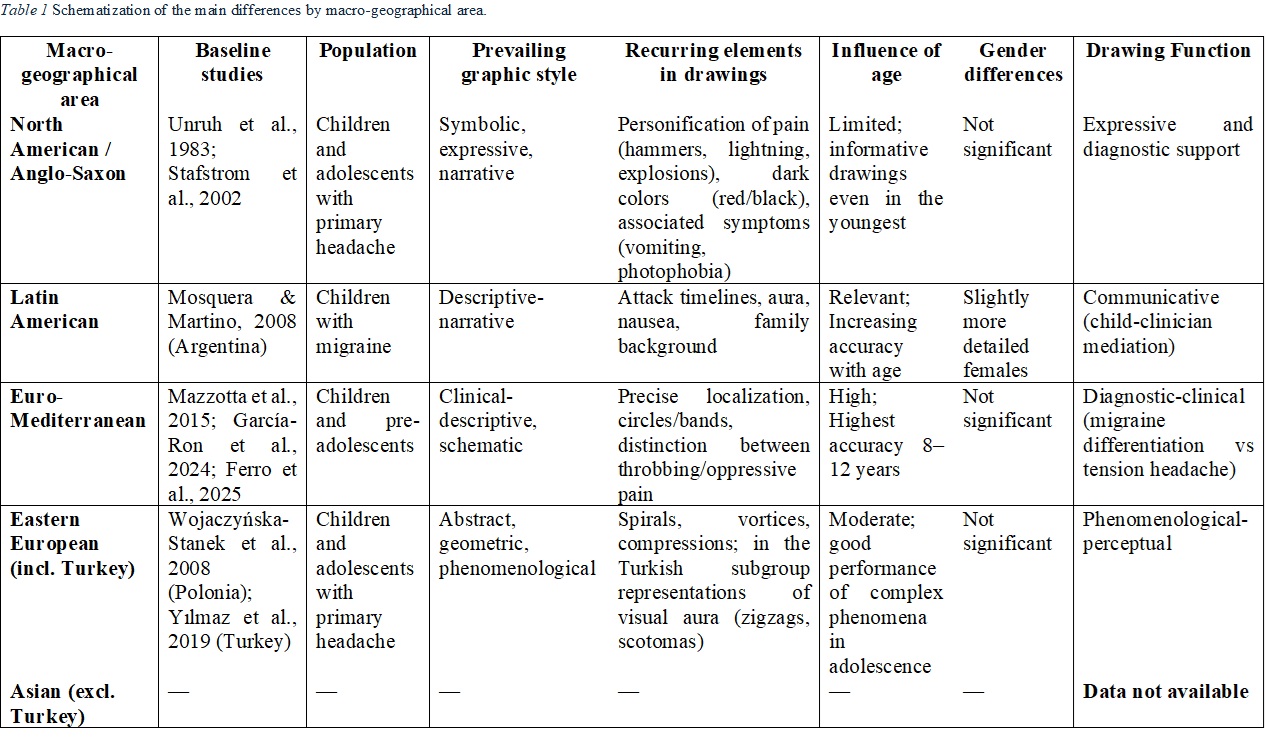
Results. Children's headache drawings reveal consistent, universal characteristics, including the depiction of pain location, intensity, and pulsation. However, children's graphic representation of headache is influenced by three main factors: developmental stage (age), gender, and cultural context. Age plays a central role, influencing the level of symbolic complexity, with more structured and detailed representations emerging with the development of cognitive abilities. Gender differences are relatively limited, although boys tend to represent pain more mechanical while girls more frequently express emotional aspects. Cultural background significantly influences the way pain is symbolized and interpreted. Drawing serves different functions across cultural contexts: it appears more expressive in Anglo-Saxon and North American contexts, more communicative in Latin American contexts, more clinically and diagnostically oriented in European contexts, and more phenomenological and perceptive in Eastern European contexts. Table 1 summarizes the main findings.
Conclusions. Overall, the results suggest that the interpretation of children's drawings should take into account the child's developmental level and cultural context to improve understanding of the child's subjective experience and communication between patient, family, and clinician.
Downloads
Download data is not yet available.
1. Ferro F, Gaspari C, Manfrè G, et al. Children’s headache through drawings: a narrative review and a portrait gallery. Life (Basel) 2025;15:996.
How to Cite
1.
DRAWING AS A DEVELOPMENTAL AND TRANSCULTURAL CLINICAL TOOL IN THE DIAGNOSIS OF PEDIATRIC HEADACHES: F. Cernigliaro1, E. Correnti2, D. Lopes3, R. Nardello4, A. Messina5, G. Santangelo6, C. Balzanelli7, V. Raieli8 | 1Servizio Territoriale Azienda Sanitaria Provinciale 6, Palermo, Italy; 2UO NPI Arnas Civico, Palermo, Italy; 3UO NPI Arnas Civico, Palermo, Italy; 4Dipartimento Materno Infantile Università di Palermo, Italy; 5Libero Professionista Audiologo, Palermo, Italy; 6UO NPI Arnas Civico, Palermo, Italy; 7Centro Vertigini San Bernardino Poliambulatorio, Salò, Italy; 8UO NPI Arnas Civico, Palermo, Italy. Adv Health Res [Internet]. 2026 Sep. 21 [cited 2026 Sep. 29];3(s2). Available from: https://www.ahr-journal.org/site/article/view/232
Copyright (c) 2026 The Author(s)


This work is licensed under a Creative Commons Attribution-NonCommercial 4.0 International License.
PAGEPress has chosen to apply the Creative Commons Attribution NonCommercial 4.0 International License (CC BY-NC 4.0) to all manuscripts to be published.