

 https://doi.org/10.4081/ahr.2026.184
MULTIMODAL ELECTROPHYSIOLOGIC AND CEREBRAL PERFUSION ASSESSMENT OF LOSS OF CONSCIOUSNESS IN CALVES DURING SLAUGHTER: TRANSLATIONAL IMPLICATIONS FOR PAIN CONSCIOUSNESS MONITORING
V.P. Pham1, V.Y. Tran2, A.A. Al Alwany3, G. Farì4, D. Myrcik5, N. Cimini6, M.L.G. Leoni7, G. Varrassi8 | 1Department of Biomedical Engineering, International University, Vietnam National University, Ho Chi Minh city, Vietnam; 2Department of Biomedical Engineering, International University, Vietnam National University, Ho Chi Minh City, Vietnam; 3College of Medicine, University of Baghdad, Iraq; 4Department of Experimental Medicine (Di.Me.S.), University of Salento, Lecce, Italy; 5Department of Internal Diseases Propaedeutics and Emergency Medicine, Medical University of Silesia, Bytom, Poland; 6Department of MESVA, University of L’Aquila, Italy; 7Department of Medical and Surgical Sciences and Translational Medicine, Sapienza University of Rome, Italy; 8Fondazione Paolo Procacci, Rome, Italy
All claims expressed in this article are solely those of the authors and do not necessarily represent those of their affiliated organizations, or those of the publisher, the editors and the reviewers. Any product that may be evaluated in this article or claim that may be made by its manufacturer is not guaranteed or endorsed by the publisher.
Published: 6 May 2026
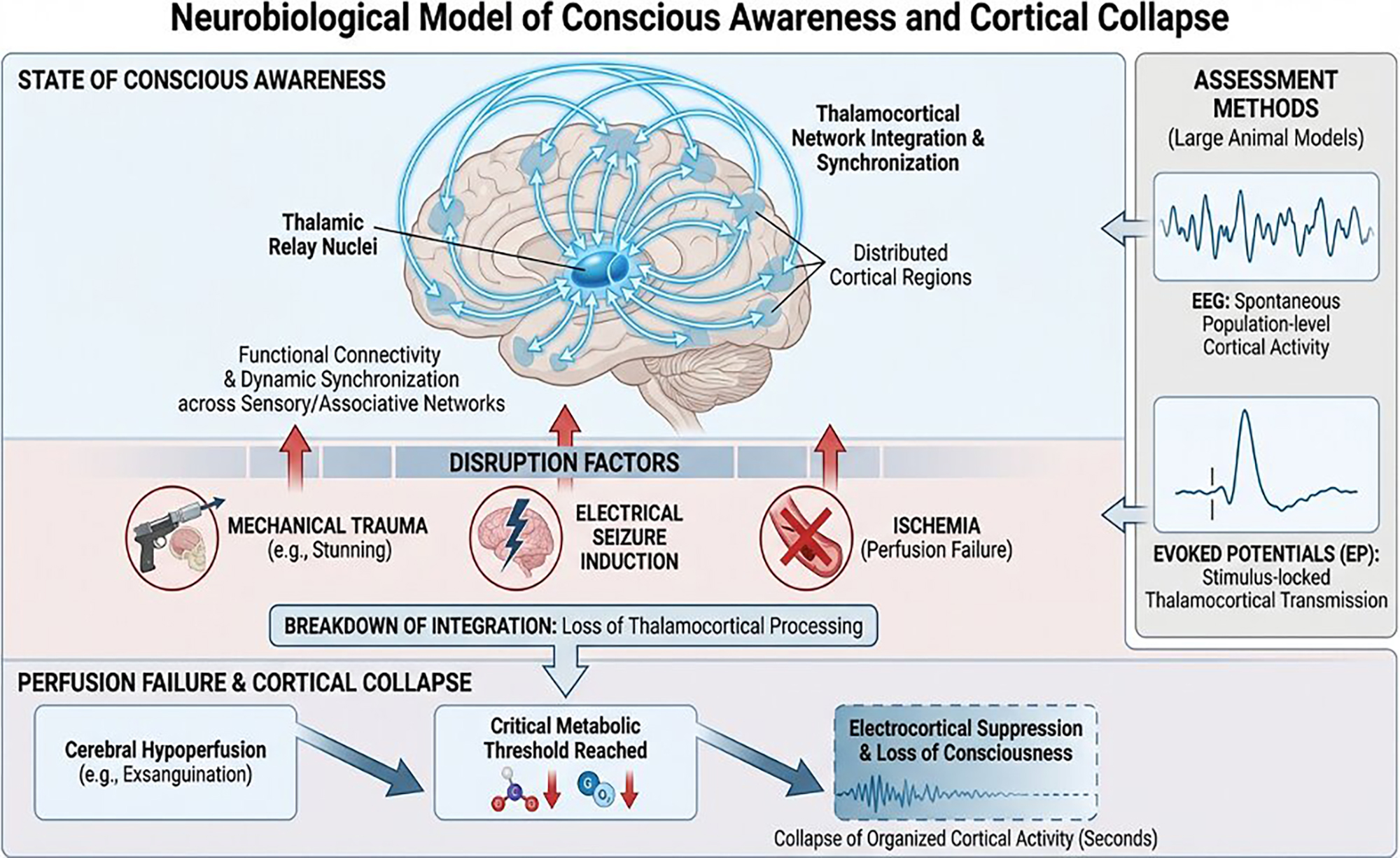
Background and Aims. Conscious pain perception requires preserved thalamocortical connectivity and functional integration across sensory, associative, and limbic cortical networks. Determining loss of consciousness cannot be reliably inferred from behavioral indicators alone, as brainstem reflexes and motor activity may persist beyond electrocortical suppression. This structured narrative review aimed to synthesize electrophysiologic and cerebral perfusion evidence within a mechanistic framework defining cortical non-responsiveness and to clarify the relative utility of available monitoring endpoints.
Methods. A structured narrative review was conducted following SANRA criteria. PubMed/MEDLINE was searched from inception to January 2026 using terms encompassing EEG, electrocorticography, evoked potentials, cerebral blood flow, stunning, and exsanguination. Inclusion was restricted to peer-reviewed studies reporting direct neurophysiologic endpoints in bovines. Evidence was synthesized qualitatively, prioritizing mechanistic interpretation over statistical aggregation.
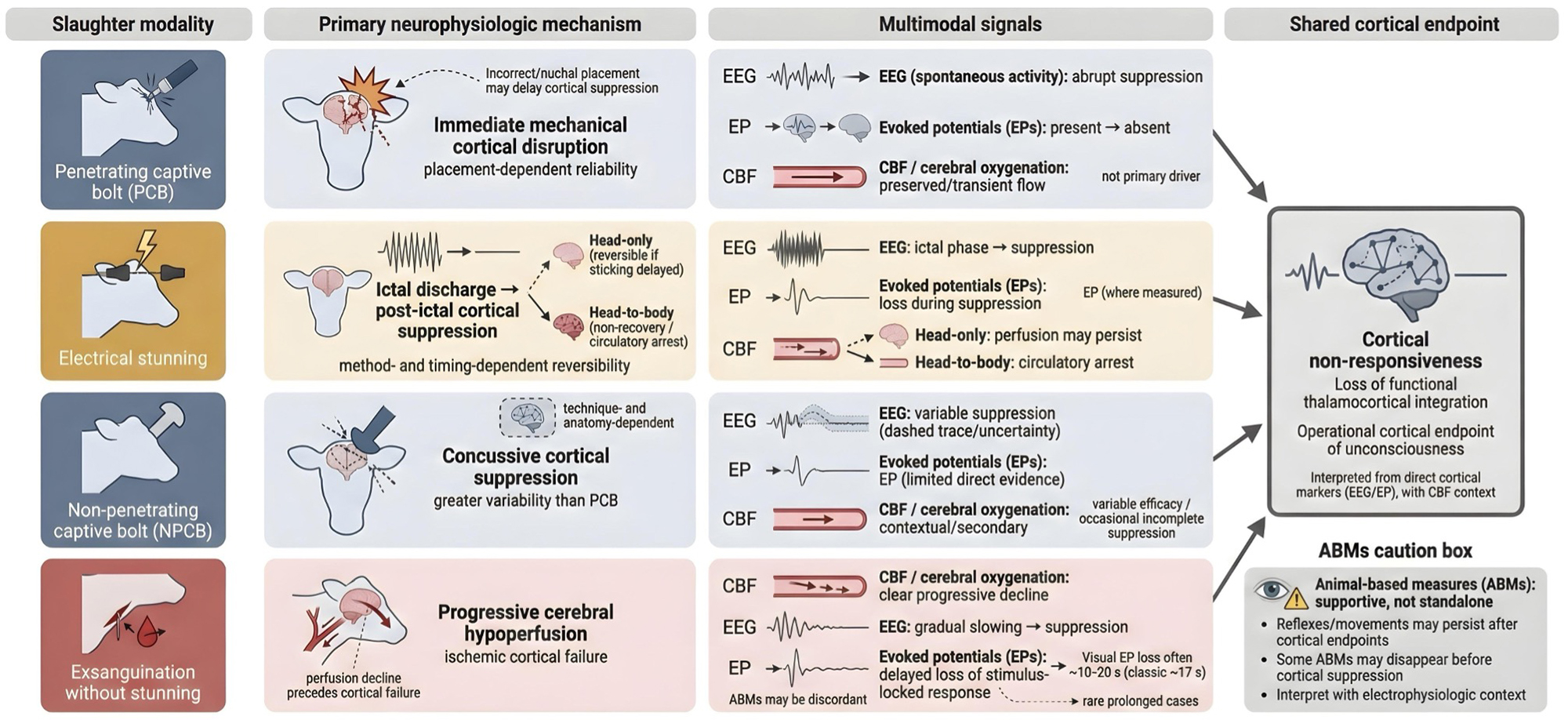
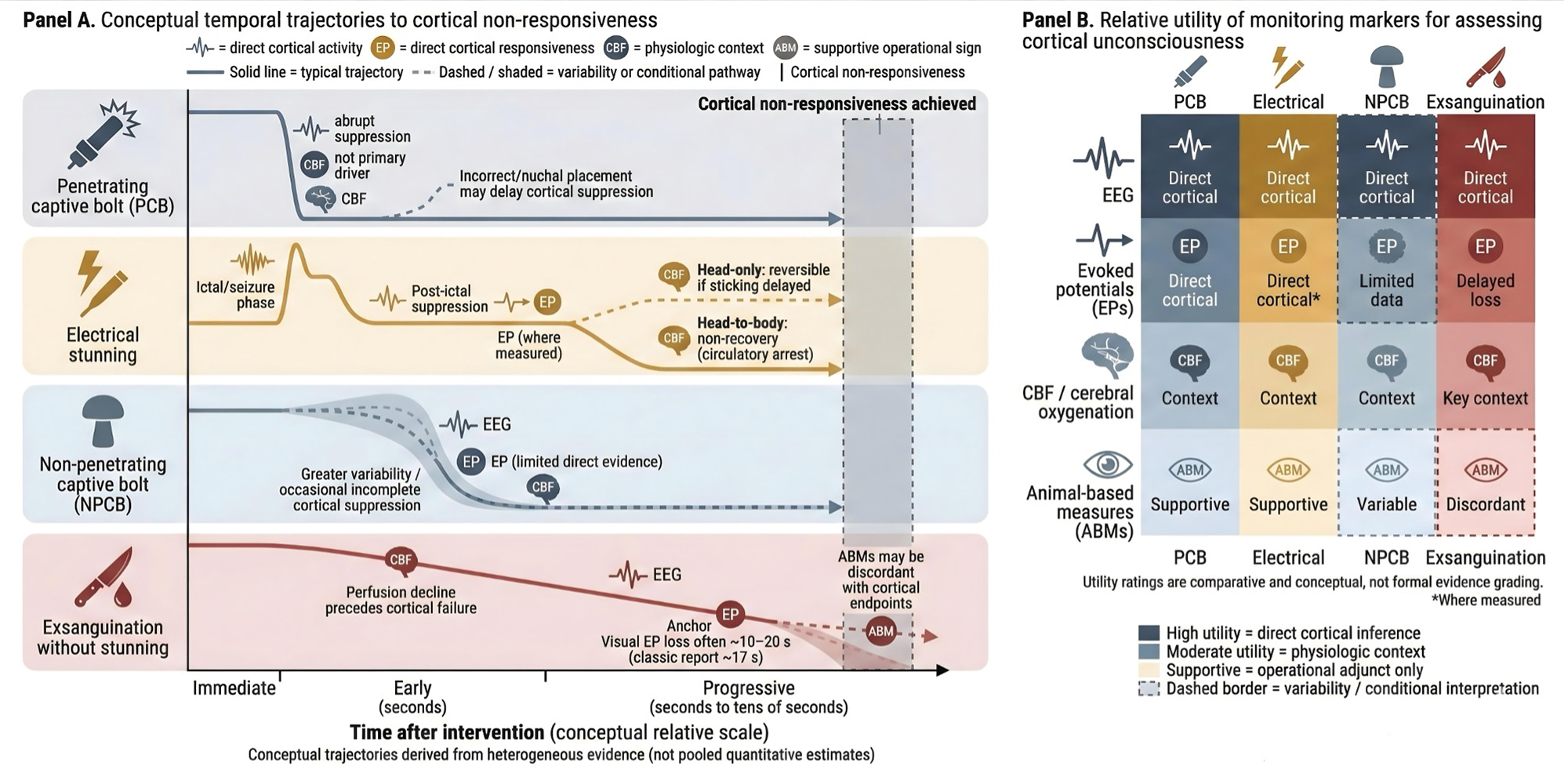
Results. Penetrating captive bolt stunning produces a rapid abolition of evoked cortical responses, confirming rapid thalamocortical alterations. Electrical stunning induces a characteristic ictal-suppressive EEG sequence incompatible with conscious processing. Progressive cerebral hypoperfusion during exsanguination leads to loss of visually evoked cortical responsiveness within approximately 17 seconds, with measurable interindividual variability. Animal-based behavioral measures demonstrate imperfect concordance with EEG-defined cortical endpoints, confirming their inadequacy as standalone consciousness markers. Integration of EEG with cerebral blood flow metrics enables mechanistic differentiation between concussive, post-ictal, and ischemic pathways to cortical failure.
Conclusions. EEG and evoked potentials remain important direct markers of cortical unconsciousness; cerebral perfusion assessment provides complementary physiologic validation. Multimodal integration represents the most scientifically defensible framework for reducing interpretive uncertainty in consciousness monitoring.

Downloads
How to Cite

This work is licensed under a Creative Commons Attribution-NonCommercial 4.0 International License.
PAGEPress has chosen to apply the Creative Commons Attribution NonCommercial 4.0 International License (CC BY-NC 4.0) to all manuscripts to be published.