

 https://doi.org/10.4081/ahr.2026.142
Enhancing rigor in narrative reviews: protocol for the validation of a structured narrative review framework via Delphi consensus
All claims expressed in this article are solely those of the authors and do not necessarily represent those of their affiliated organizations, or those of the publisher, the editors and the reviewers. Any product that may be evaluated in this article or claim that may be made by its manufacturer is not guaranteed or endorsed by the publisher.
Accepted: 18 May 2026
Published: 3 July 2026
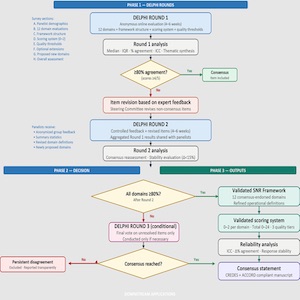
Narrative reviews remain essential for synthesizing complex, multidisciplinary evidence, particularly in heterogeneous and evolving fields. However, their intrinsic subjectivity, risk of selection bias and limited reproducibility have raised important methodological concerns. This study aims to describe the development of the Structured Narrative Review (SNR) Framework, an advanced model designed to enhance methodological rigor while preserving interpretative flexibility, and to present the protocol for its formal validation through an international expert consensus process. The SNR Framework integrates established reporting standards, including SANRA, PRISMA 2020 and PRISMA-ScR. It is organized into core domains addressing reproducible search strategies, evidence stratification, mechanistic synthesis and epistemological transparency. Although the framework is conceptually grounded in methodological triangulation, formal validation is required to confirm its clarity, feasibility and applicability across disciplines. This protocol describes an international modified Delphi consensus study designed to validate the SNR Framework. The primary objective is to achieve expert agreement on the relevance, clarity, and feasibility of each core domain, as well as on the overall framework structure, standardized scoring system and recommendations for integration into editorial and peer-review workflows. The consensus process will involve two to three sequential electronic rounds conducted in accordance with CREDES and ACCORD recommendations. An international panel of 30-50 experts will independently rate each SNR domain across dimensions of relevance, clarity and feasibility. Consensus will be defined as ≥80% agreement. Items failing to reach consensus will be revised and resubmitted in subsequent rounds. As this is a protocol, no results are yet available. Upon completion, the study is expected to yield a validated SNR Framework with expert-endorsed core domains, a standardized scoring system and consensus-based implementation recommendations, thereby advancing transparency, rigor and reproducibility in narrative review methodology.
Downloads
1. Green BN, Johnson CD, Adams A. Writing narrative literature reviews for peer-reviewed journals: secrets of the trade. J Chiropr Med 2006;5:101–17. DOI: https://doi.org/10.1016/S0899-3467(07)60142-6
2. Ferrari R. Writing narrative style literature reviews. Med Writ 2015;24:230–5. DOI: https://doi.org/10.1179/2047480615Z.000000000329
3. Sukhera J. Narrative reviews: flexible, rigorous, and practical. J Grad Med Educ 2022;14:414–7. DOI: https://doi.org/10.4300/JGME-D-22-00480.1
4. Campbell M, Katikireddi SV, Sowden A, Thomson H. Lack of transparency in reporting narrative synthesis of quantitative data: a methodological assessment of systematic reviews. J Clin Epidemiol 2019;105:1–9. DOI: https://doi.org/10.1016/j.jclinepi.2018.08.019
5. Baethge C, Goldbeck-Wood S, Mertens S. SANRA—a scale for the quality assessment of narrative review articles. Res Integr Peer Rev 2019;4:5. DOI: https://doi.org/10.1186/s41073-019-0064-8
6. Page MJ, McKenzie JE, Bossuyt PM, et al. The PRISMA 2020 statement: an updated guideline for reporting systematic reviews. BMJ 2021;372:n71. DOI: https://doi.org/10.1136/bmj.n71
7. Tricco AC, Lillie E, Zarin W, et al. PRISMA Extension for Scoping Reviews (PRISMA-ScR): checklist and explanation. Ann Intern Med 2018;169:467–73. DOI: https://doi.org/10.7326/M18-0850
8. Arksey H, O'Malley L. Scoping studies: towards a methodological framework. Int J Soc Res Method 2005;8:19–32. DOI: https://doi.org/10.1080/1364557032000119616
9. Aromataris E, Lockwood C, Porritt K, Pilla B, Jordan Z, editors. JBI Manual for Evidence Synthesis. JBI; 2024. DOI: https://doi.org/10.46658/JBIMES-24-01
10. Popay J, Roberts H, Sowden A, et al. Guidance on the conduct of narrative synthesis in systematic reviews: a product from the ESRC Methods Programme. Version 1. 2006.
11. Grant MJ, Booth A. A typology of reviews: an analysis of 14 review types and associated methodologies. Health Info Libr J 2009;26:91–108. DOI: https://doi.org/10.1111/j.1471-1842.2009.00848.x
12. Humphrey-Murto S, Wood TJ, Gonsalves C, et al. The Delphi method. Acad Med 2020;95:168. DOI: https://doi.org/10.1097/ACM.0000000000002887
13. Barrett D, Heale R. What are Delphi studies? Evid Based Nurs 2020;23:68–9. DOI: https://doi.org/10.1136/ebnurs-2020-103303
14. Niederberger M, Renn O. Delphi Methods in the Social and Health Sciences: Concepts, Applications and Case Studies. Wiesbaden: Springer; 2023. DOI: https://doi.org/10.1007/978-3-658-38862-1
15. Nasa P, Jain R, Juneja D. Delphi methodology in healthcare research: how to decide its appropriateness. World J Methodol 2021;11:116–29. DOI: https://doi.org/10.5662/wjm.v11.i4.116
16. Diamond IR, Grant RC, Feldman BM, et al. Defining consensus: a systematic review recommends methodologic criteria for reporting of Delphi studies. J Clin Epidemiol 2014;67:401–9. DOI: https://doi.org/10.1016/j.jclinepi.2013.12.002
17. Brady SR. Utilizing and adapting the Delphi method for use in qualitative research. Int J Qual Methods 2015;14:1–6. DOI: https://doi.org/10.1177/1609406915621381
18. Jünger S, Payne SA, Brine J, Radbruch L, Brearley SG. Guidance on Conducting and REporting DElphi Studies (CREDES) in palliative care: recommendations based on a methodological systematic review. Palliat Med 2017;31:684–706. DOI: https://doi.org/10.1177/0269216317690685
19. Gattrell WT, Logullo P, van Zuuren EJ, et al. ACCORD (ACcurate COnsensus Reporting Document): a reporting guideline for consensus methods in biomedicine developed via a modified Delphi. PLoS Med 2024;21:e1004326. DOI: https://doi.org/10.1371/journal.pmed.1004326
20. Simera I, Moher D, Hoey J, Schulz KF, Altman DG. A catalogue of reporting guidelines for health research. Eur J Clin Invest 2010;40:35–53. DOI: https://doi.org/10.1111/j.1365-2362.2009.02234.x
21. Chan AW, Tetzlaff JM, Altman DG, et al. SPIRIT 2013 statement: defining standard protocol items for clinical trials. Ann Intern Med 2013;158:200-7. DOI: https://doi.org/10.7326/0003-4819-158-3-201302050-00583
22. International Committee of Medical Journal Editors (ICMJE). Recommendations for the conduct, reporting, editing, and publication of scholarly work in medical journals. Updated 2023. Available from: https://www.icmje.org
23. Manyara AM, Purvis A, Ciani O, et al. Sample size in multistakeholder Delphi surveys: at what minimum sample size do replicability of results stabilize? J Clin Epidemiol 2024;174:111485. DOI: https://doi.org/10.1016/j.jclinepi.2024.111485
24. Crane D, Henderson EJ, Chadwick DR. Exploring the acceptability of a 'limited patient consent procedure' for a proposed blood-borne virus screening programme: a Delphi consensus building technique. BMJ Open 2017;7:e015373. DOI: https://doi.org/10.1136/bmjopen-2016-015373
25. Akins RB, Tolson H, Cole BR. Stability of response characteristics of a Delphi panel: application of bootstrap data expansion. BMC Med Res Methodol 2005;5:37. DOI: https://doi.org/10.1186/1471-2288-5-37
26. Hsu CC, Sandford BA. The Delphi technique: making sense of consensus. Pract Assess Res Eval 2007;12:1–8.
27. Holey EA, Feeley JL, Dixon J, Whittaker VJ. An exploration of the use of simple statistics to measure consensus and stability in Delphi studies. BMC Med Res Methodol 2007;7:52. DOI: https://doi.org/10.1186/1471-2288-7-52
28. von der Gracht HA. Consensus measurement in Delphi studies: review and implications for future quality assurance. Technol Forecast Soc Change 2012;79:1525-36. DOI: https://doi.org/10.1016/j.techfore.2012.04.013
29. Koo TK, Li MY. A guideline of selecting and reporting intraclass correlation coefficients for reliability research. J Chiropr Med 2016;15:155-63. DOI: https://doi.org/10.1016/j.jcm.2016.02.012
30. World Medical Association. World Medical Association Declaration of Helsinki: ethical principles for medical research involving human subjects. JAMA 2013;310:2191–4. DOI: https://doi.org/10.1001/jama.2013.281053
31. Snyder H. Literature review as a research methodology: an overview and guidelines. J Bus Res 2019;104:333–9. DOI: https://doi.org/10.1016/j.jbusres.2019.07.039
32. Shea BJ, Reeves BC, Wells G, et al. AMSTAR 2: a critical appraisal tool for systematic reviews that include randomised or non-randomised studies of healthcare interventions, or both. BMJ 2017;358:j4008.
33. Spranger J, Homberg A, Sonnberger M, Niederberger M. Reporting guidelines for Delphi techniques in health sciences: a methodological review. Z Evid Fortbild Qual Gesundhwes 2022;172:1–11. DOI: https://doi.org/10.1016/j.zefq.2022.04.025
34. Hohmann E, Glatt V, Engel T, Tetsworth K. Guidelines for designing and conducting Delphi consensus studies within medical and surgical specialties. Arthroscopy 2025;41:903–13. DOI: https://doi.org/10.1016/j.arthro.2025.03.038
How to Cite

This work is licensed under a Creative Commons Attribution-NonCommercial 4.0 International License.
PAGEPress has chosen to apply the Creative Commons Attribution NonCommercial 4.0 International License (CC BY-NC 4.0) to all manuscripts to be published.