
 https://doi.org/10.4081/ahr.2026.140
EEG-CBF integration in calf slaughter neurophysiology: a narrative review
All claims expressed in this article are solely those of the authors and do not necessarily represent those of their affiliated organizations, or those of the publisher, the editors and the reviewers. Any product that may be evaluated in this article or claim that may be made by its manufacturer is not guaranteed or endorsed by the publisher.
Published: 29 July 2026
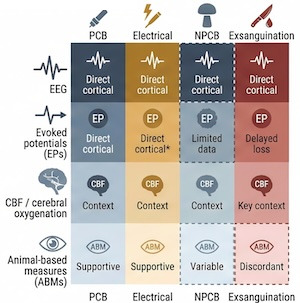
Loss of consciousness (LOC) during calf slaughter is a neurophysiological process that requires distinction between cortical awareness and reflexive subcortical or spinal activity. Conscious perception depends on intact thalamocortical connectivity and integrated cortical function. Electroencephalography (EEG) and evoked potentials provide indirect measures of cortical activity, while cerebral blood flow (CBF) is the physiological prerequisite for maintaining cortical function. When cerebral perfusion fails, organized cortical electrical activity rapidly ceases. This review synthesizes current evidence on the neurophysiological effects of different slaughter methods in calves by integrating electrophysiological findings with cerebral perfusion data relevant to animal welfare assessment. A structured narrative review was conducted according to SANRA principles. PubMed/MEDLINE was systematically searched from database inception to January 2026 using predefined terms related to calves, cattle, EEG, evoked potentials, cerebral perfusion, stunning techniques, exsanguination without stunning, and religious slaughter. Only peer-reviewed studies reporting direct neurophysiological endpoints in cattle or calves were included. Correctly applied penetrating captive bolt induces rapid cortical changes consistent with loss of cortical function, with pathological evidence also demonstrating disruption of subcortical and brainstem structures. Proper electrical stunning produces an ictal phase followed by post-ictal cortical suppression characterized by EEG patterns incompatible with conscious processing. Non-penetrating captive bolt also achieves electrocortical suppression under controlled conditions, although with greater variability. In contrast, exsanguination without prior stunning causes a rapid reduction in cerebral perfusion pressure and CBF, supported by carotid hemodynamic and computational studies, although direct intracerebral measurements during slaughter are lacking. Electrophysiological studies consistently report EEG patterns compatible with LOC within single-digit seconds. Overall, current evidence indicates that catastrophic loss of cerebral perfusion after carotid transection results in rapid LOC, while available EEG findings during slaughter without stunning are consistent with this conclusion. Future validation of combined EEG-perfusion monitoring under commercial slaughter conditions may reduce uncertainty in neurophysiological welfare assessment.
Downloads
1. Sgourdou P. The consciousness of pain: a thalamocortical perspective. NeuroSci 2022;3:311-20. DOI: https://doi.org/10.3390/neurosci3020022
2. Ong WY, Stohler CS, Herr DR. Role of the prefrontal cortex in pain processing. Mol Neurobiol 2019;56:1137-66. DOI: https://doi.org/10.1007/s12035-018-1130-9
3. Garcia-Larrea L, Bastuji H. Pain and consciousness. Prog Neuropsychopharmacol Biol Psychiatry 2018;87:193-9. DOI: https://doi.org/10.1016/j.pnpbp.2017.10.007
4. Daly C, Kallweit E, Ellendorf F. Cortical function in cattle during slaughter: conventional captive bolt stunning followed by exsanguination compared with shechita slaughter. Vet Rec 1988;122:325-9. DOI: https://doi.org/10.1136/vr.122.14.325
5. Bager F, Braggins TJ, Devine CE, et al. Onset of insensibility at slaughter in calves: effects of electroplectic seizure and exsanguination on spontaneous electrocortical activity and indices of cerebral metabolism. Res Vet Sci 1992;52:162-73. DOI: https://doi.org/10.1016/0034-5288(92)90005-M
6. Gregory NG, Wotton SB. Time to loss of brain responsiveness following exsanguination in calves. Res Vet Sci 1984;37:141-3. DOI: https://doi.org/10.1016/S0034-5288(18)31895-2
7. Verhoeven MTW, Gerritzen MA, Hellebrekers LJ, et al. Validation of indicators used to assess unconsciousness in veal calves at slaughter. Anim Int J Anim Biosci 2016;10:1457-65. DOI: https://doi.org/10.1017/S1751731116000422
8. Lay CC, Davis MF, Chen‐Bee CH, et al. Mild sensory stimulation protects the aged rodent from cortical ischemic stroke after permanent middle cerebral artery occlusion. J Am Heart Assoc 2012;1:e001255. DOI: https://doi.org/10.1161/JAHA.112.001255
9. Grandin T. Return-to-sensibility problems after penetrating captive bolt stunning of cattle in commercial beef slaughter plants. J Am Vet Med Assoc 2002;221:1258-61. DOI: https://doi.org/10.2460/javma.2002.221.1258
10. Lambooy E, Spanjaard W. Effect of the shooting position on the stunning of calves by captive bolt. Vet Rec 1981;109:359-61. DOI: https://doi.org/10.1136/vr.109.16.359
11. Gibson TJ, Oliveira SEO, Costa FAD, et al. Electroencephalographic assessment of pneumatically powered penetrating and non-penetrating captive-bolt stunning of bulls. Meat Sci 2019;151:54-9. DOI: https://doi.org/10.1016/j.meatsci.2019.01.006
12. Hascalovici JR, Pozzi P, Yvorchuk K, et al. Vertebral artery contribution to cerebral cortex perfusion in cattle after slaughter by ventral neck incision: a systematic review. Front Vet Sci 2026;13:1760260. DOI: https://doi.org/10.3389/fvets.2026.1760260
13. Benchimol A, Parmentier T, Hascalovici J, et al. Impact of carotid artery sectioning on cerebral blood flow in bovines: a numerical hemodynamic study. Am J Vet Res 2026;87:ajvr.25.09.0347. DOI: https://doi.org/10.2460/ajvr.25.09.0347
14. Baethge C, Goldbeck-Wood S, Mertens S. SANRA - a scale for the quality assessment of narrative review articles. Res Integr Peer Rev 2019;4:5. DOI: https://doi.org/10.1186/s41073-019-0064-8
15. Müller EJ, Munn BR, Redinbaugh MJ, et al. The non-specific matrix thalamus facilitates the cortical information processing modes relevant for conscious awareness. Cell Rep 2023;42:112844. DOI: https://doi.org/10.1016/j.celrep.2023.112844
16. Whyte CJ, Redinbaugh MJ, Shine JM, et al. Thalamic contributions to the state and contents of consciousness. Neuron 2024;112:1611-25. DOI: https://doi.org/10.1016/j.neuron.2024.04.019
17. Cacciatore M, Magnani FG, Barbadoro F, et al. Thalamus and consciousness: a systematic review on thalamic nuclei associated with consciousness. Front Neurol 2025;16:1509668. DOI: https://doi.org/10.3389/fneur.2025.1509668
18. Kumar P, Abubakar AA, Sazili AQ, et al. Application of electroencephalography in preslaughter management: a review. Animals (Basel) 2022;12:2857. DOI: https://doi.org/10.3390/ani12202857
19. Zulkifli I, Goh YM, Norbaiyah B, et al. Changes in blood parameters and electroencephalogram of cattle as affected by different stunning and slaughter methods in cattle. Anim Prod Sci 2014;54:187-93. DOI: https://doi.org/10.1071/AN12128
20. Aubert A, Costalat R. A model of the coupling between brain electrical activity, metabolism, and hemodynamics: application to the interpretation of functional neuroimaging. NeuroImage 2002;17:1162-81. DOI: https://doi.org/10.1006/nimg.2002.1224
21. Van Lieshout JJ, Wieling W, Karemaker JM, et al. Syncope, cerebral perfusion, and oxygenation. J Appl Physiol 2003;94:833-48. DOI: https://doi.org/10.1152/japplphysiol.00260.2002
22. Devine CE, Tavener A, Graafhuis AE, et al. Electroencephalographic studies of calves associated with electrical stunning, throat cutting and carcass electro-immobilisation. N Z Vet J 1987;35:107-12. DOI: https://doi.org/10.1080/00480169.1987.35400
23. Devine CE, Tavener A, Gilbert KV, et al. Electroencephalographic studies of adult cattle associated with electrical stunning, throat cutting and carcass electro-immobilization. N Z Vet J 1986;34:210-3. DOI: https://doi.org/10.1080/00480169.1986.35352
24. Beausoleil N, Farouk M, Webster J, et al. Comparison of recovery of sheep, goats, and calves from reversible electrical head-only and head-to-body stunning for halal meat production. N Z Vet J 2024;72:288-99. DOI: https://doi.org/10.1080/00480169.2024.2367532
25. Musk GC, Johnson CB. Commentary: a comparison of the methods of the pre-slaughter stunning of cattle in Australia - mechanical, electrical, and diathermic syncope. Animals (Basel) 2024;14:3141. DOI: https://doi.org/10.3390/ani14213141
26. Gibson T, Johnson C, Murrell J, et al. Electroencephalographic responses to concussive non-penetrative captive-bolt stunning in halothane-anaesthetised calves. N Z Vet J 2009;57:90-5. DOI: https://doi.org/10.1080/00480169.2009.36884
27. Small A, Jenson I, Phillips A, et al. Cattle recover completely from unconsciousness induced by controlled application of 150-180 kJ of 915 MHz microwave energy to the forehead. Vet Anim Sci 2025;29:100466. DOI: https://doi.org/10.1016/j.vas.2025.100466
28. Pozzi P, Hascalovici J, Yvorchuk K, et al. Is vertebral artery circulation adequate to support consciousness following Shechita? Preprints.org 2025. DOI: https://doi.org/10.20944/preprints202507.2206.v1
29. Anil MH, McKinstry JL, Wotton SB, et al. Welfare of calves - 1. Investigations into some aspects of calf slaughter. Meat Sci 1995;41:101-12. DOI: https://doi.org/10.1016/0309-1740(94)00075-I
30. Sherman DL, Thakor NV. EEG signal processing: theory and applications. In: He B, editor. Neural Engineering. Cham, Springer; 2020. p. 97-129. DOI: https://doi.org/10.1007/978-3-030-43395-6_3
31. Chung CKE, Poon CCM, Irwin MG. Peri‐operative neurological monitoring with electroencephalography and cerebral oximetry: a narrative review. Anaesthesia 2022;77:113-22. DOI: https://doi.org/10.1111/anae.15616
32. Nischal SA, Patel S, Yuen J, et al. Cerebral blood flow and modern approaches for clinical assessment & monitoring: a view to the future. Br J Neurosurg 2025. Online ahead of print. DOI: https://doi.org/10.1080/02688697.2025.2602629
33. Gallucci A, Varoli E, Del Mauro L, et al. Multimodal approaches supporting the diagnosis, prognosis and investigation of neural correlates of disorders of consciousness: A systematic review. Eur J Neurosci 2024;59:874-933. DOI: https://doi.org/10.1111/ejn.16149
34. Varrassi G, Tran VY, Pham VP, et al. Multimodal electrophysiologic and cerebral perfusion assessment of loss of consciousness in calves during slaughter: a narrative review. Preprints 2026, 2026022042. DOI: https://doi.org/10.20944/preprints202602.2042.v1
CRediT authorship contribution
Y Van Tran, formal analysis, writing - original draft preparation, writing - review & editing. Phong Van Pham, formal analysis, writing - original draft preparation, writing - review & editing. Ameen A. Al Alwany, writing - review & editing. Dariusz Myrcik, methodology. Giacomo Farì, methodology. Nicola Cimini, formal analysis, writing - original draft preparation, writing - review & editing. Matteo Luigi Giuseppe Leoni, methodology, formal analysis, writing - original draft preparation, writing - review & editing. Giustino Varrassi, conceptualization, supervision.
Data Availability Statement
The data that support the findings of this study are available on request from the corresponding author.
How to Cite

This work is licensed under a Creative Commons Attribution-NonCommercial 4.0 International License.
PAGEPress has chosen to apply the Creative Commons Attribution NonCommercial 4.0 International License (CC BY-NC 4.0) to all manuscripts to be published.