

 https://doi.org/10.4081/ahr.2026.136
Artificial intelligence applications for wound management in nursing palliative care: a narrative review
All claims expressed in this article are solely those of the authors and do not necessarily represent those of their affiliated organizations, or those of the publisher, the editors and the reviewers. Any product that may be evaluated in this article or claim that may be made by its manufacturer is not guaranteed or endorsed by the publisher.
Published: 5 August 2026
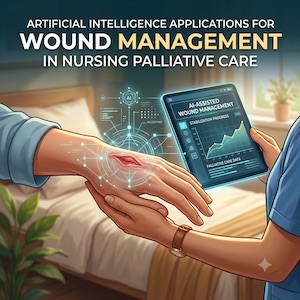
In contemporary practice, artificial intelligence (AI) has evolved into a practical tool for clinical decision-making and diagnostic accuracy in healthcare. In wound management, AI-based tools enable the analysis of tissue types, precise size measurement, and automated boundary delineation. This narrative review aims to synthesize current evidence on the role of AI in nursing practice for wound management within palliative care settings. It evaluates technical applications, ethical implications, and nursing readiness to provide strategic directions for clinical practice and education. A comprehensive search was conducted in PubMed and ScienceDirect for literature published up to 12 February 2026, focusing on AI, machine learning, wound care, and nursing. The database search identified 1,228 records. After screening and eligibility assessment, approximately 20 studies relevant to the aims of this narrative review were thematically synthesized. Thematically synthesized findings suggest that AI technologies, particularly computer vision and predictive analytics, may enhance wound assessment accuracy and documentation. Mobile platforms support remote monitoring and telemedicine, which is crucial for rural and home-based palliative settings. While AI offers tools for prognostication and decision-making, nurses express a need for better training to address concerns regarding algorithmic bias, privacy, and the preservation of the relational aspect of care.AI serves as a powerful partner that supports nursing expertise rather than replacing it. In palliative care, its value lies in providing objective assessments and enabling proactive responses to patient needs while maintaining a focus on comfort and dignity. Integrating AI fundamentals into nursing curricula and professional development is essential. Furthermore, nurse participation in the design and governance of AI ensures they align with professional values and clinical workflows.
Downloads
1. Anisuzzaman DM, Wang C, Rostami B et al. Image-based artificial intelligence in wound assessment: a systematic review. Adv Wound Care (New Rochelle) 2022;11:687-709. DOI: https://doi.org/10.1089/wound.2021.0091
2. Le DTP, Pham TD. Unveiling the role of artificial intelligence for wound assessment and wound healing prediction. Explor Med 2023;4:1001163. DOI: https://doi.org/10.37349/emed.2023.00163
3. Griffa D, Natale A, Merli Y, et al. Artificial intelligence in wound care: a narrative review of the currently available mobile apps for automatic ulcer segmentation. BioMedInformatics 2024;4:2321-37. DOI: https://doi.org/10.3390/biomedinformatics4040126
4. Chadwick P. The role of artificial intelligence in wound care: applications, evidence and future directions. Wounds Int 2025;16:28-41.
5. Koumaki D, Kostakis G, Boumpoucheropoulos S, et al. A narrative review of management of wounds in palliative care setting. Ann Palliat Med 2023;12:1089-105. DOI: https://doi.org/10.21037/apm-23-138
6. Sezgin D, Geraghty J, Graham T, et al. Defining palliative wound care: a scoping review by european association for palliative care wound care taskforce. J Tissue Viability 2023;32:627-34. DOI: https://doi.org/10.1016/j.jtv.2023.07.002
7. Chrisman CA. Care of chronic wounds in palliative care and end-of-life patients. Int Wound J 2010;7:214-35. DOI: https://doi.org/10.1111/j.1742-481X.2010.00682.x
8. Ronan I, Tabirca S, Murphy D, et al. Artificially intelligent nursing homes: a scoping review of palliative care interventions. Front Digit Health 2025;7:1484304. DOI: https://doi.org/10.3389/fdgth.2025.1484304
9. Abejas AG, Santos DG, Costa FL, et al. Ethical challenges and opportunities of ai in end-of-life palliative care: integrative review. Interact J Med Res 2025;14:e73517. DOI: https://doi.org/10.2196/73517
10. Oh O, Demiris G, Ulrich CM. The ethical dimensions of utilizing artificial intelligence in palliative care. Nurs Ethics 2025;32:1285-96. DOI: https://doi.org/10.1177/09697330241296874
11. Bozkurt S, Fereydooni S, Karet I, al. AI in palliative care: a scoping review of foundational gaps and future directions for responsible innovation. J Pain Symptom Manage 2025;70:e394-e418. DOI: https://doi.org/10.1016/j.jpainsymman.2025.08.009
12. Barakat-Johnson M, Jones A, Burger M, et al. Reshaping wound care: evaluation of an artificial intelligence app to improve wound assessment and management amid the covid-19 pandemic. Int Wound J 2022;19:1561-77. DOI: https://doi.org/10.1111/iwj.13755
13. Barakat-Johnson M, Jones A, Burger M, et al. Reshaping wound care: evaluation of an artificial intelligence app to improve wound assessment and management. Stud Health Technol Inform 2024;310:941-45. DOI: https://doi.org/10.3233/SHTI231103
14. Raizman R, Ramírez-GarciaLuna JL, Newaz T, et al. Empowering patients and caregivers to use artificial intelligence and computer vision for wound monitoring: nonrandomized, single-arm feasibility study. J Particip Med 2025;17:e69470. DOI: https://doi.org/10.2196/69470
15. Freeman S, Sargent MJ, Rodriguez Galarza L, et al. Use of artificial intelligence-driven wound care management to enhance access to care in rural and northern communities. Int Wound J 2025;22:e70767. DOI: https://doi.org/10.1111/iwj.70767
16. Sürme Y, Topan H, Maraş Baydoğan G. How successful is ai in developing postsurgical wound care education material? Wound Repair Regen 2025;33:e70041. DOI: https://doi.org/10.1111/wrr.70041
17. Pinto A, Santos C, Aguiar R, et al. The use of artificial intelligence in palliative care communication: a narrative review. Cureus 2025;17:e80524. DOI: https://doi.org/10.7759/cureus.80524
18. Gürdap Z, Öner U. Nurses' attitudes toward artificial intelligence applications and their clinical decision-making competence: a cross-sectional study. Nurse Educ Today 2026;160:107014. DOI: https://doi.org/10.1016/j.nedt.2026.107014
19. El Arab RA, Alshakihs AH, Alabdulwahab SH, et al. Artificial intelligence in nursing: a systematic review of attitudes, literacy, readiness, and adoption intentions among nursing students and practicing nurses. Front Digit Health 2025;7:1666005. DOI: https://doi.org/10.3389/fdgth.2025.1666005
20. Alrashedi H, Alderaan SM, Alnomasy N, et al. Insights into factors affecting nurses' knowledge of and attitudes toward AI and implications for successful ai integration in critical care: cross-sectional study. JMIR Nurs 2026;9:e85649. DOI: https://doi.org/10.2196/85649
21. Buchanan C, Howitt ML, Wilson R et al. Predicted influences of artificial intelligence on the domains of nursing: scoping review. JMIR Nurs 2021;4:e23933. DOI: https://doi.org/10.2196/23933
22. Ceylan H. Nurses' perspectives on the interaction of artificial intelligence and spirituality in palliative care units: a qualitative research. Turk J Health Sci Life 2025;8:72-82. DOI: https://doi.org/10.56150/tjhsl.1738995
23. Encarnação R, Alves J, Marques A, et al. Artificial intelligence in wound care education: scoping review. Nurse Educ Today 2025;155:106872. DOI: https://doi.org/10.1016/j.nedt.2025.106872
24. Dornan M. Every nurse an ai nurse: a framework for integrating artificial intelligence across nursing practice, education, research and policy. Digit Health 2025. Online Ahead of Print. DOI: https://doi.org/10.1177/20552076251377939
How to Cite

This work is licensed under a Creative Commons Attribution-NonCommercial 4.0 International License.
PAGEPress has chosen to apply the Creative Commons Attribution NonCommercial 4.0 International License (CC BY-NC 4.0) to all manuscripts to be published.